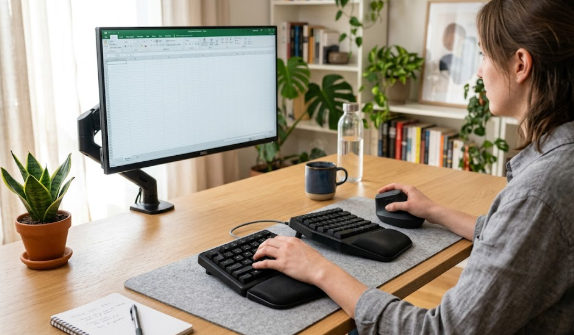
It may sound surprising that a keyboard and mouse could affect your back, but the connection is real. When your keyboard is awkward and your mouse forces your hand into an unnatural position, you compensate by hunching your shoulders, twisting your forearms, and reaching forward, and that upper-body tension travels straight down into your neck and upper back. An ergonomic keyboard and mouse keep your shoulders relaxed, your chest open, and your forearms and wrists aligned, which removes a hidden source of the strain that builds up over a long working day.
To be clear, no peripheral fixes back pain on its own; the foundation is still a good chair, a correctly positioned screen, and regular movement. But once those are in place, the right keyboard and mouse remove the last layer of upper-body strain. In this guide we cover the best ergonomic keyboards and mice for 2026, explain how they help your posture, and show you how to set them up. They are one piece of the wider picture in our home office ergonomic setup guide.
How ergonomic peripherals help your posture
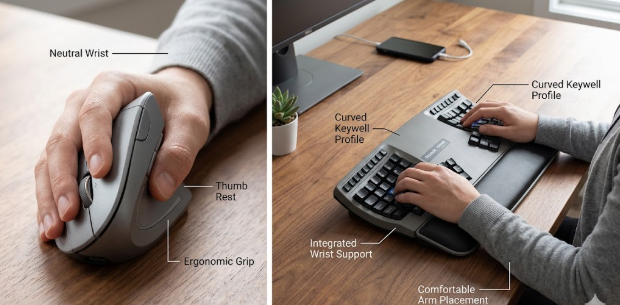
Standard keyboards force your wrists outward into what specialists call ulnar deviation, and standard mice make you rotate your forearm so your palm faces down, a position called pronation. Both are unnatural, and holding them for hours strains tendons and the median nerve while quietly pulling your shoulders and arms out of a relaxed position. Split and tented keyboards let your hands sit at the natural width and angle of your shoulders, keeping your wrists in line with your forearms, while vertical mice rotate your hand into a neutral handshake position that stops the forearm twisting. The upshot is more open shoulders and a more relaxed upper back, which is exactly what protects your neck and spine during long sessions.
One honest caveat, echoed by reviewers and ergonomists alike: equipment alone will not solve discomfort if you sit still for hours. The first fix is always to stand up and move regularly, as covered in our back pain exercises for remote workers guide. Treat ergonomic peripherals as the finishing touch on a setup that already gets the big things right.
The best ergonomic keyboards in 2026
Logitech ERGO K860 — Best for most people
The Logitech ERGO K860 is the keyboard we recommend to the majority of remote workers because it delivers genuine ergonomic benefits without the steep learning curve of fully split boards. Its gently curved, split key layout and generous pillowed wrist rest keep your wrists and forearms in a natural, supported position, the scissor switches are comfortable and quiet, and it connects wirelessly to multiple devices at once. It is a refined, accessible upgrade over a flat keyboard and an easy first step into ergonomic typing.
MoErgo Glove80 — Best for enthusiasts
For people who want the most adjustable, deeply ergonomic typing experience, the MoErgo Glove80 is widely regarded as one of the best split keyboards available. Its two fully separate halves let you position each hand exactly at shoulder width and angle, and the contoured key wells reduce finger travel and keep your wrists flat and relaxed. It demands an adaptation period and costs more than a mainstream board, but for heavy typists who want to optimise every detail of their hand position, it is a standout.
Kinesis split keyboard — Best for serious split and tenting
Kinesis has long been a respected name in ergonomic keyboards, and its split designs let you separate the two halves and tent them so the middle edges rise, putting your wrists nearly in line with your forearms and opening up your chest and shoulders. Some models even place a trackpad between the halves to minimise mouse travel. Tenting does not suit everyone, so it is worth trying, but for those who get on with it, a Kinesis split board is a serious, durable ergonomic tool.
A budget mechanical or low-profile board — Best value
You do not have to spend a lot to improve your typing posture. Several budget-friendly ergonomic and low-profile keyboards offer a gentle split, adjustable tilt, or a comfortable wrist rest at a fraction of the price of premium boards. If you are not ready to commit to a full split design, a well-reviewed budget option with a wrist rest is a sensible, low-risk way to find out whether ergonomic typing helps you before investing more.
The best ergonomic mice in 2026
Logitech MX Vertical — Best for wrist relief
If you already feel a dull ache in your wrist by the afternoon, the Logitech MX Vertical is the standout choice. It holds your hand at a roughly 57-degree angle, the neutral handshake position ergonomists recommend, which eliminates the forearm twisting of a flat mouse and takes pressure off the carpal tunnel and median nerve. The build quality is excellent and it pairs naturally with a split keyboard, letting you keep the mouse closer to your body’s midline and reduce shoulder rotation. For office workers feeling persistent wrist strain, it is the most effective everyday pick.
Logitech MX Master 3S — Best all-round productivity mouse
The MX Master 3S is not a fully vertical mouse, but its sculpted, palm-filling shape supports the hand far better than a flat mouse and reduces the clawed grip that strains the fingers and forearm. Its precision sensor works on almost any surface, including glass, which makes it a great choice for people who work in different spots around the home. If you want ergonomic comfort without committing to the unusual feel of a vertical mouse, this is the balanced choice.
Anker Vertical Mouse — Best budget vertical
For a low-cost way to try the vertical handshake position, the Anker vertical mouse delivers the core ergonomic benefit, removing forearm pronation, at a budget-friendly price. It lacks the premium materials and advanced features of the MX Vertical, but it is an excellent, affordable entry point for anyone curious about whether a vertical mouse eases their wrist and forearm strain.
At-a-glance comparison
The table below summarises the picks above. Prices are approximate United States figures and can change, so always confirm current pricing before buying.
| Product | Type | Best for | Approx. price |
|---|---|---|---|
| Logitech ERGO K860 | Curved split keyboard | Most people | ~$130 |
| MoErgo Glove80 | Full split keyboard | Enthusiasts | ~$300+ |
| Kinesis split | Split + tenting keyboard | Serious ergonomics | ~$200 – $360 |
| Budget ergonomic board | Split / low-profile | Value | ~$50 – $100 |
| Logitech MX Vertical | Vertical mouse | Wrist relief | ~$100 |
| Logitech MX Master 3S | Sculpted mouse | All-round productivity | ~$100 |
| Anker Vertical Mouse | Vertical mouse | Budget | ~$30 |
How to set up your keyboard and mouse
Position your keyboard and mouse so your forearms stay level and your wrists straight, neither bent up, down, nor sideways, and keep them close enough that you are not reaching forward, which strains the shoulders and upper back. If you use a laptop, the single most important upgrade is to raise the laptop on a stand to bring the screen to eye level and then use a separate keyboard and mouse, because a laptop alone forces a compromise that wrecks either your neck or your wrists. Our guide to the best monitor stands covers raising your screen, and the wider setup is in our home office ergonomic setup guide.
Give yourself time to adapt; split keyboards and vertical mice can take one to four weeks before they feel natural, so do not judge them on day one. Keep your shoulders relaxed rather than hunched, let your wrists float or rest lightly rather than pressing hard into a wrist rest, and remember that the best posture is still your next one, so get up and move regularly. You can compare detailed keyboard reviews at RTINGS and browse the full range on the official Logitech site.
Frequently asked questions
Can a keyboard and mouse really affect my back?
Indirectly, yes. They mainly affect the wrists and forearms, but an awkward keyboard or mouse makes you hunch your shoulders, twist your arms, and reach forward, and that upper-body tension contributes to neck and upper-back strain. Keeping your hands in a natural position helps keep your shoulders and upper back relaxed, which supports better overall posture.
Are split keyboards worth the learning curve?
For people who type for many hours a day, often yes. Split and tented designs keep your wrists aligned and your shoulders open, which can noticeably reduce strain once you adapt, typically within a few weeks. If you type less or want a gentler change, a curved board like the Logitech ERGO K860 offers many of the benefits with little adjustment.
Is a vertical mouse better than a regular ergonomic mouse?
A vertical mouse offers the most dramatic reduction in forearm twisting because it holds your hand in a handshake position, which is ideal for people already feeling wrist strain. A sculpted mouse like the MX Master 3S is more familiar and still far better than a flat mouse, making it a good middle ground for those who find vertical mice unusual.
Do I need a wrist rest?
A wrist rest can help by supporting your hands during pauses, but it should not be something you press into hard while typing or mousing, as that can create pressure points. Use it to rest lightly between bursts of activity, and keep your wrists straight and relaxed while you work.
The bottom line
An ergonomic keyboard and mouse are the finishing touch on a healthy workspace, removing the upper-body strain that pulls your posture out of line. For most people the Logitech ERGO K860 paired with the MX Vertical or MX Master 3S is an excellent, accessible combination, while enthusiasts can go further with a fully split board. Set them up so your wrists stay straight and your shoulders relaxed, give yourself time to adapt, and keep moving through the day. To get the foundation right first, start with our best ergonomic chairs for back pain guide.
Affiliate disclosure: This article contains affiliate links. If you buy a product through one of them, we may earn a small commission at no extra cost to you. This never influences which products we recommend.
Medical disclaimer: We are not doctors or physiotherapists, and this article is for general informational purposes only. It is not medical advice and should not replace consultation with a qualified healthcare professional. If you have persistent, severe, or worsening pain, including wrist or back pain, please seek advice from a licensed medical provider.