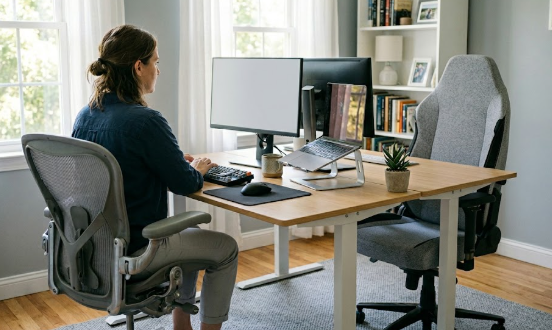
It is one of the most common questions among remote workers shopping for a serious chair: should you buy the Herman Miller Aeron, the long-reigning icon of office ergonomics, or the Secretlab Titan Evo, the gaming-born chair that has won over countless people who sit for ten-hour stretches? Both are excellent, both support healthy posture, and both cost real money. But they are built around fundamentally different philosophies, and the right choice depends entirely on how you sit and what your back needs.
In this head-to-head comparison we break down lumbar support, materials, adjustability, comfort over long sessions, price, and warranty, so you can decide which chair belongs in your home office. If you are still weighing other models too, it is worth reading our wider roundup of the best ergonomic chairs for back pain before committing.
The quick verdict
If you spend most of your day doing focused desk work in an upright posture and you want a chair that gently guides your spine into place with minimal fiddling, the Herman Miller Aeron is the stronger choice. If your day mixes work with gaming, reading, and frequent reclining, and you want a softer, cushioned feel at a much lower price, the Secretlab Titan Evo is the better fit. Neither is objectively “wrong” for back pain; they simply suit different sitting styles and budgets.
Price and value
The gap here is significant. The Herman Miller Aeron typically starts at around $1,800 and climbs higher with fully adjustable arms and PostureFit SL lumbar support, placing it firmly in premium-investment territory. The Secretlab Titan Evo, by contrast, usually sells for around $549, occasionally reaching the upper $600s for premium upholstery editions.
That difference does not automatically make the Titan the better value, though. The Aeron is engineered to last decades and is backed by a far longer warranty, so the cost-per-year of ownership narrows considerably over time. The Titan delivers an enormous amount of comfort and support for the money up front, which makes it the more accessible pick for anyone who cannot justify a four-figure outlay. Both represent good value within their own brackets.
Back and lumbar support: the most important factor
For people dealing with back pain, this is where the decision is really made. The Aeron uses its well-known PostureFit SL system, which supports both the lumbar region and the sacral area at the base of the spine, encouraging the natural S-curve of your back and helping you stay upright without slumping. Combined with the 8Z Pellicle suspension mesh, which flexes into eight zones of varying tension, the result is even pressure distribution and very little of the “hot spot” discomfort that builds up over a long day.
The Titan Evo takes a different route with its integrated four-way adjustable lumbar support, which you can move up, down, and in and out to dial in the exact firmness and position you want. It is genuinely effective and more configurable than almost any other chair in the gaming category. The key difference is feel: the Aeron’s mesh creates a floating, suspended sensation, while the Titan’s firm cold-cure foam offers a more cushioned, enveloping support. Whichever you choose, pairing it with the right setup matters; our guide to the best lumbar support for office chairs covers how to fine-tune this for your own back.
Materials and build quality
The Aeron is built on a die-cast aluminium frame with its signature breathable mesh, a combination that keeps you cool and structurally supported for years. There is no foam to compress or sag over time, which is part of why these chairs hold up so well. The Titan Evo uses a sturdy metal frame wrapped in cold-cure foam and your choice of leatherette or fabric upholstery, giving it a plush, warmer feel. Foam can soften over years of heavy use, though Secretlab’s medium-firm formulation is designed to resist that better than typical office padding. In short, the Aeron prioritises longevity and airflow, while the Titan prioritises immediate cushioned comfort.
Adjustability and fit
Both chairs are highly adjustable, but in different ways. The Aeron comes in three sizes (A, B, and C), so you can match the chair to your body rather than forcing your body to fit the chair, and it offers adjustable arms, tilt, and lumbar support. The Titan Evo also comes in three sizes (Small, Regular, XL) and features 4D armrests that move in four directions, a magnetic memory-foam head pillow, and a multi-tilt mechanism. If you love tweaking every parameter, both will satisfy you; the Titan’s headrest is a notable extra that the standard Aeron does not include.
Comfort and posture over long sessions
This is where personal preference dominates. The Aeron holds you in a structured, upright posture almost automatically, which many people with lower-back issues find reassuring because it discourages slumping without conscious effort. The Titan encourages postural variety, supporting you comfortably whether you are leaning in to type or reclining to read, and its head pillow makes longer reclined sessions noticeably more comfortable. Whichever you pick, remember that no chair is a substitute for movement; building in regular breaks and a few back pain exercises for remote workers will do more for your spine than any single piece of furniture. Even the Mayo Clinic emphasises that good office ergonomics is about the whole setup and habits, not just the seat.
Recline and movement
The Titan Evo recline is one of its standout strengths, letting you tilt back substantially and lock the position, which suits people who alternate between work and relaxation throughout the day. The Aeron reclines more modestly and is tuned around its tilt mechanism that keeps you supported as you shift, reflecting its focus on active desk work rather than deep lounging. If you want a chair you can genuinely lean back and decompress in, the Titan has the edge.
Warranty and long-term ownership
Herman Miller backs the Aeron with a 12-year warranty, one of the longest in the industry, which underlines how long these chairs are built to last and softens the high purchase price over time. Secretlab offers a warranty that can be extended to five years, shorter than the Aeron’s but generous for the gaming-chair category. There is also a practical difference worth knowing: the Aeron has a thriving certified-refurbished market, so you can often find remanufactured units at a fraction of the new price, whereas the Titan is generally bought new.
At-a-glance comparison
The table below summarises the main differences. Prices are approximate United States figures and can change, so always confirm current pricing before buying.
| Feature | Herman Miller Aeron | Secretlab Titan Evo |
|---|---|---|
| Approx. price | ~$1,800+ | ~$549 – $669 |
| Back support | PostureFit SL + 8Z mesh | 4-way adjustable lumbar + foam |
| Feel | Suspended, breathable, firm | Cushioned, enveloping, warm |
| Sizes | A, B, C | Small, Regular, XL |
| Headrest | Not standard | Magnetic memory-foam pillow |
| Best for | Upright focused desk work | Hybrid work, gaming, recline |
| Warranty | 12 years | Up to 5 years |
| Refurbished market | Yes, widely available | Generally new only |
Which should you buy?
Choose the Herman Miller Aeron if you do mostly focused, upright desk work, you value breathability and a chair that supports correct posture with minimal effort, and you see seating as a long-term health investment you will keep for a decade or more. Choose the Secretlab Titan Evo if you want premium comfort at roughly a third of the price, your day includes gaming or frequent reclining, and you prefer a softer, cushioned feel with a built-in headrest. If neither feels quite right, you might also consider a completely different design philosophy, which we explore in our ergonomic chair vs kneeling chair comparison.
You can review full specifications on the official Herman Miller Aeron page and the official Secretlab Titan Evo page before deciding.
Frequently asked questions
Is the Aeron worth three times the price of the Titan Evo?
It depends on your priorities. The Aeron offers superior breathability, a posture-guiding design, a 12-year warranty, and decades of durability, which spreads its cost over a very long ownership period. The Titan Evo delivers most of the everyday comfort and adjustability for a fraction of the upfront cost. For pure value, the Titan wins; for long-term investment and structured posture support, the Aeron justifies its price.
Which is better specifically for lower back pain?
Both can help, but in different ways. The Aeron’s PostureFit SL is purpose-built to support the lower spine and sacrum and tends to require less manual adjustment to feel right. The Titan’s four-way lumbar is more configurable, so people who like to dial in an exact position often prefer it. If you want the most hands-off lower-back support, lean Aeron; if you want maximum adjustability, lean Titan.
Can I use a gaming chair like the Titan for serious office work?
Yes. The Titan Evo has far more genuine ergonomic engineering than typical racing-style gaming chairs, with real adjustable lumbar support and 4D arms, and many remote workers use it full-time. It is best for people who want postural variety and recline rather than the dynamic, spine-following flex of a dedicated office chair.
Should I buy a refurbished Aeron instead?
For many buyers, yes. A certified-refurbished or remanufactured Aeron from a reputable dealer can cost roughly half the new price while still carrying a warranty, giving you flagship back support at a mid-range cost. Just make sure the seller inspects and reconditions the chairs rather than reselling untested used units.
The bottom line
The Herman Miller Aeron and the Secretlab Titan Evo are both genuinely excellent chairs, and neither will let your back down if it is set up properly. The Aeron is the choice for upright, focused work and long-term value, while the Titan Evo is the choice for cushioned comfort, recline, and a far friendlier price. Match the chair to how you actually sit, set it up correctly, and keep moving throughout the day. For a complete workspace, pair whichever you choose with the tips in our home office ergonomic setup guide.
Affiliate disclosure: This article contains affiliate links. If you buy a product through one of them, we may earn a small commission at no extra cost to you. This never influences which products we recommend.
Medical disclaimer: We are not doctors or physiotherapists, and this article is for general informational purposes only. It is not medical advice and should not replace consultation with a qualified healthcare professional. If you have persistent, severe, or worsening back pain, please seek advice from a licensed medical provider.