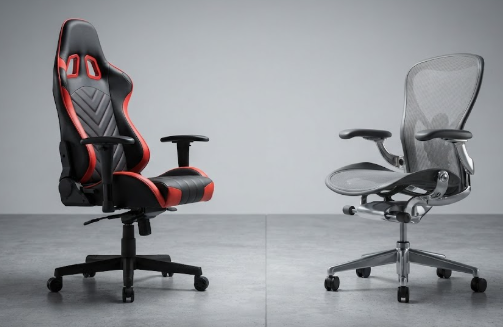
If you spend long hours at a desk, working, gaming, or both, few debates spark as much argument as office chair versus gaming chair. Gaming chairs look fast and feel plush the moment you sit down; ergonomic office chairs look plain but are built by companies that have spent decades studying how the human body handles eight-hour workdays. For back pain specifically, the two are not equal, but the honest answer is more nuanced than the internet’s shouting matches suggest: the category matters less than fit, setup, and how often you move, and within that, ergonomic design holds real advantages over long hours.
This guide compares office and gaming chairs for back pain across support, seat design, materials, and durability, and helps you decide which suits you. If you want to see the debate embodied in two specific icons, our Herman Miller Aeron vs Secretlab Titan comparison pits a classic ergonomic chair against the best-regarded gaming chair.
The honest headline
Experts who sell and test both agree on the broad picture: for pure seated work over long hours, a good ergonomic office chair generally beats a gaming chair at the same price, because more of a gaming chair’s cost goes into its looks. One 2019 study reported that ergonomic chairs with adjustable lumbar support reduced lower-back discomfort substantially compared with standard seating during prolonged sitting. That said, a well-designed gaming chair with adjustable lumbar, 4D armrests, a wide flat seat, and a controlled recline can support your spine comparably when set up correctly, and a cheap version of either type will hurt your back equally. No chair fixes your posture on its own; small, frequent position changes matter more than any single seat.
What gaming chairs do well, and where they fall short for back pain
Gaming chairs earn their popularity honestly. They offer striking racing-inspired styling, thick high-density padding that feels supportive at first, a generous recline that can reach far back for breaks, and often 4D armrests and included head and lumbar pillows. For someone who games a few hours in the evening with breaks, that is often enough.
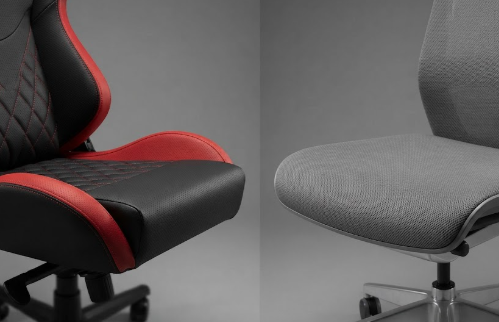
The problems appear over long workdays. The racing-style bucket seat has hard side bolsters that, while they stabilise you during sudden movements, are unnecessary at a desk and can pinch broader thighs, crowd the shoulders, and make it impossible to sit cross-legged. Most gaming chairs rely on lumbar pillows rather than integrated, adjustable lumbar support, and those pillows do not always fit your body and tend to drift out of position. Many have a fixed seat depth with no slider, which prevents a proper fit. Their PU leather or leatherette traps heat and grows sweaty, and on cheaper models it can peel or crack within a year. And their overall lifespan, often two to four years before the padding flattens, trails the five to ten years or more of a quality office chair.
What office chairs do well
Ergonomic office chairs are designed around long-term spinal health rather than aesthetics. Their standout strength is integrated, adjustable lumbar support that sits in the curve of your lower back and, on better models, adapts as you move, which directly targets where desk workers feel the most pain. They typically offer adjustable seat depth for proper thigh support, breathable mesh that prevents the heat buildup of leatherette, and a synchronised tilt that lets the seat and back move naturally with you. Build quality and longevity are usually far higher, and the whole design applies biomechanics research to help you hold a healthy posture without conscious effort. The trade-offs are that they look more understated, often recline less dramatically, and the best ones cost more, though at a given price they usually deliver more genuine ergonomic function.
At-a-glance comparison
The table below summarises the main differences for back pain. Individual models vary, so treat these as general tendencies.
| Feature | Gaming chair | Ergonomic office chair |
|---|---|---|
| Lumbar support | Usually a pillow (can drift) | Integrated & adjustable |
| Seat design | Bucket seat with bolsters | Flat, often with depth adjustment |
| Breathability | Lower (PU leather traps heat) | Higher (mesh options) |
| Recline | Very deep (good for breaks) | Moderate, synchronised tilt |
| Durability | ~2–4 years typical | ~5–10+ years |
| Aesthetics | Bold, racing style | Clean, neutral |
| Best for | Casual mixed use & looks | Long work hours & back support |
The verdict by use case
If your chair is mainly a workstation where you sit for eight or more hours, choose an ergonomic office chair; its adjustable lumbar support, seat depth, breathability, and durability make it the better long-term investment for your back. If you mostly game casually in the evenings with plenty of breaks and you value the look and deep recline, a gaming chair can be perfectly fine, provided you pick one with adjustable lumbar support, 4D armrests, and ideally a wide, flat seat rather than an aggressive bucket, and you set it up properly. And if you want the best of both, look either at a good ergonomic office chair, which works just as well for gaming, or at a hybrid ergonomic-gaming chair that adds a bolder look and features like a footrest to a genuinely supportive base.
The exceptions worth knowing
Not every gaming chair is compromised. The Secretlab Titan Evo is widely praised because it replaced the hard bolsters with softer padding, giving a wide, fully usable seat, which is why reviewers often rate it the best true gaming chair for support. At the same time, many experts point out that the best chair for gaming is frequently not marketed as a gaming chair at all: a task or office chair like the Herman Miller Aeron is a perennial recommendation for all-day gaming precisely because it lasts for years and keeps you cool and supported. Hybrid chairs that blend office ergonomics with a gaming aesthetic are also increasingly good. The label matters far less than the features.
What matters more than the choice
Whichever category you choose, the fundamentals decide whether your back feels good. Set your lumbar support at belt level in the curve of your lower back, keep your feet flat with your knees at roughly a right angle, position your armrests so your shoulders stay relaxed, and use a light recline of around 100 to 115 degrees rather than sitting rigidly upright. Above all, move: change position and stand up every thirty to forty-five minutes, because variety beats any single posture and static “perfect” sitting still leads to fatigue and pain. It is also worth remembering that you spend even more hours on your mattress than in any chair, so if you are investing in your back, do not neglect your sleep surface, as covered in our best mattress for back pain guide. For chairs built specifically for marathon sessions, see our guide to the best office chairs for long hours.
Frequently asked questions
Are gaming chairs bad for your back?
Not inherently, but many have features that work against long-term back comfort, such as hard bucket bolsters, lumbar pillows instead of integrated support, fixed seat depth, and heat-trapping materials. A well-designed gaming chair with adjustable lumbar, 4D armrests, and a wide flat seat, set up correctly, can support your spine well, while a poorly fitted or cheap one can cause pain. Fit and setup matter more than the label.
Is an office chair or gaming chair better for working from home?
For full-time desk work of eight or more hours, an ergonomic office chair is generally the better choice, thanks to its adjustable integrated lumbar support, seat-depth adjustment, breathability, and longer lifespan. A gaming chair suits people who mainly game casually with breaks and value the aesthetic. At the same price, an office chair usually offers more genuine ergonomic function for work.
Can a gaming chair be good for back pain?
Yes, if you choose carefully. Look for adjustable or dynamic lumbar support rather than a loose pillow, 4D armrests, a controlled light recline, and a wide, flat seat without aggressive bolsters, like the Secretlab Titan Evo. Then set it up correctly and take regular movement breaks. Under those conditions, a good gaming chair can support a neutral spine comparably to an office chair.
Which lasts longer, a gaming chair or an office chair?
Quality office chairs typically last longer, often five to ten years or more, while many gaming chairs last around two to four years before the padding flattens and the material wears, especially cheaper PU-leather models that can peel within a year. If long-term value is a priority, a well-built office chair is usually the more durable investment.
The bottom line
For back pain over long hours, an ergonomic office chair generally has the edge, thanks to integrated adjustable lumbar support, seat-depth adjustment, breathability, and durability. A good gaming chair can work well for mixed and casual use if it has real adjustable lumbar support, 4D arms, and a wide flat seat, and if you set it up properly. But the biggest factors are fit, setup, and movement, not the label on the box. Choose the chair that fits your body and your hours, dial it in, and keep moving. To see the two philosophies go head to head, read our Aeron vs Secretlab Titan comparison.
Affiliate disclosure: This article contains affiliate links. If you buy a product through one of them, we may earn a small commission at no extra cost to you. This never influences which products we recommend.
Medical disclaimer: We are not doctors or physiotherapists, and this article is for general informational purposes only. It is not medical advice and should not replace consultation with a qualified healthcare professional. If you have persistent, severe, or worsening back pain, please seek advice from a licensed medical provider.