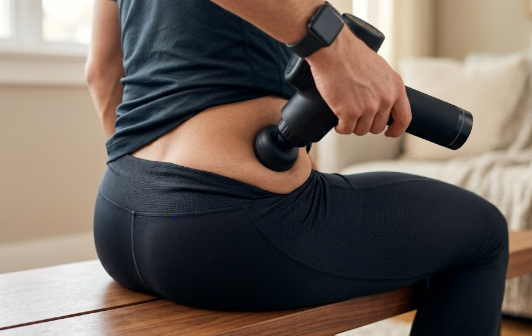
A massage gun, or percussion massager, brings something close to a deep-tissue massage into your own hands. Using rapid, repetitive strokes, it penetrates muscle tissue, stimulates blood flow, and helps interrupt the pain-and-tension cycle that builds up when the muscles around your spine stay locked in contraction all day. For the muscular side of desk-related back pain, the kind that comes from tight, fatigued, underworked soft tissue rather than a structural problem, percussive therapy can be a genuinely useful tool, and a one-time purchase that pays off over years.
It is worth being clear-eyed, though: the scientific evidence for massage guns is mixed, they treat muscle tension rather than the cause, and they come with important safety rules, including never using one directly on your spine. This guide covers the best massage guns for back pain in 2026, which muscles to target, and how to use one safely, so please read the safety section first. Percussion works best alongside other recovery tools, like the ones in our foam roller guide.
Important safety information: read this first
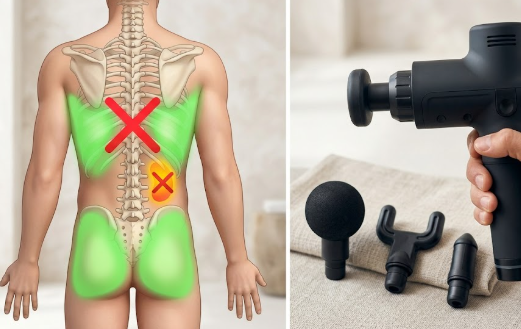
The single most important rule is this: never use a massage gun directly on your spine, vertebrae, the kidney area of your lower back just above the hip, the front or sides of your neck, or any area of acute pain or swelling. Always work the muscle tissue around the problem area, not over bone or inflamed tissue. Massage guns do not treat disc injuries and can worsen nerve irritation, so if you have pain radiating down your leg, numbness, or weakness, see a physiotherapist before using percussion therapy. The same applies to sciatica, which is nerve-related; gentle work on the surrounding glute muscles may help some people, but using a gun near irritated nerves can make things worse, so get a professional assessment first. Keep sessions short, around five to ten minutes total, once or twice a day, and no more than thirty to sixty seconds on any one muscle group, using light-to-moderate pressure with slow passes. Consult a doctor before use if you are pregnant, take blood thinners, have a clotting disorder, varicose veins, osteoporosis, or a recent injury or surgery. And new, severe, or unexplained back pain should be assessed by a healthcare professional, not self-treated.
Which muscles to target
Used correctly, a massage gun targets the muscles that contribute to back pain, not the spine itself. Three matter most. The erector spinae, the long chains of muscle running vertically along either side of the spine, absorb enormous load during sitting and tighten with prolonged desk work, so you work the muscle on each side, never the bony spine in the middle. The quadratus lumborum, deeper in the lower back, is a common source of one-sided lumbar tightness. And the glutes, often the most overlooked contributor, because when they are tight or inhibited, the lower back compensates and takes on load it was not designed for; a large ball head on the glute muscles can relieve a surprising amount of lumbar tension. The principle throughout is to release the muscles around the lower back, which is exactly the same logic as foam rolling.
What to look for in a massage gun
For back pain specifically, amplitude, meaning how far the head travels with each stroke, matters most, because stroke depth determines how effectively it reaches deeper muscle. Look for around fourteen to sixteen millimetres of amplitude for the larger muscles of the back and glutes, while remembering that more is not always better, since control and comfort matter more than raw power. Attachment heads change the experience: a flat or large ball head suits broad back muscles and glutes, while a bullet head targets specific knots, though that should be used with care. Grip ergonomics and weight affect everyday use a lot, and a rotating arm or angled handle helps enormously when you are trying to reach your own back. Beyond that, consider speed levels, battery life, and noise, and note that many people find the lowest power level is all they need.
The best massage guns for back pain in 2026
Theragun Prime — Best overall for back pain
The Theragun Prime is a strong all-round performer for back pain, with a sixteen-millimetre amplitude that reaches deep into larger muscle groups like the lower-back muscles and glutes. Therabody’s ergonomic triangular grip makes it easy to hold at different angles, including the awkward ones needed to reach your own back, and the app offers guided routines. For regular back tightness and long-term daily use, it hits the sweet spot of power, usability, and a recognised brand. See it on the official Therabody site.
Theragun PRO Plus — Best premium
If you want the most capable device and the easiest way to reach your own back, the Theragun PRO Plus is the premium standout. Its rotating arm lets you confidently hit areas of your back you simply cannot reach with a standard gun, and it pairs deep percussive force with multiple heads, app-guided routines, a force meter, and even integrated heat and red-light features. It is expensive, but for someone who wants the most powerful, self-sufficient back-care tool available, it is the best on the market.
Renpho R3 — Best budget
The Renpho R3 proves you do not need to overspend for effective muscle relief. It is compact, lightweight, and affordable, with enough power and a selection of heads to handle the back and glutes well for everyday tension. It will not match the amplitude or refinement of premium guns, but as an accessible entry point that delivers real relief, it is the value pick for most people trying percussion therapy for the first time.
Roll Recovery R1 — Best for travel and portability
For a sleek, lightweight recovery tool you can take anywhere, the Roll Recovery R1 is a favourite, especially for frequent travellers. Despite its small size it offers four attachment heads, four speeds, and up to around seven hours of battery life, all at an accessible price. It delivers genuine percussive therapy in a packable form, making it ideal for keeping your back loose on the road or at the office as well as at home.
A quiet mid-range gun — Best for shared spaces
If you work in an open-plan office or a shared home, noise matters, and several mid-range guns from established brands prioritise quiet operation without sacrificing useful power. A quieter device lets you ease back tension during the workday or while others are nearby without the loud drone of cheaper models. For anyone who wants effective relief that does not announce itself to the whole room, a quiet mid-range gun is the sensible choice.
At-a-glance comparison
The table below summarises the picks above. Prices are approximate United States figures and can change, so always confirm current pricing before buying.
| Massage gun | Best for | Notable feature | Approx. price |
|---|---|---|---|
| Theragun Prime | Overall | 16 mm amplitude, ergonomic grip | ~$250 – $300 |
| Theragun PRO Plus | Premium | Rotating arm, heat & red light | ~$500 – $600 |
| Renpho R3 | Budget | Lightweight, affordable | ~$80 – $130 |
| Roll Recovery R1 | Travel | Compact, ~7 hr battery | ~$129 |
| Quiet mid-range gun | Shared spaces | Low-noise operation | ~$150 – $300 |
How to use a massage gun for back pain
Technique beats power. Let the gun do the work, gliding it slowly over the muscle with light-to-moderate pressure rather than pressing hard, and pause briefly on tight spots without lingering. Work the erector spinae on each side of the spine, the lower-back muscles, and the glutes, always staying on muscle and away from the spine, kidneys, and bony areas. Keep to short sessions and limit time on any one muscle. Percussion pairs well with other approaches: use it to loosen muscles before gentle back pain exercises, alternate it with heat from a heating pad for stiffness, and remember it eases muscle tension but does not fix the cause, so a supportive setup from our best ergonomic chairs guide and regular movement still do the heavy lifting.
Frequently asked questions
Do massage guns actually help back pain?
For muscular tension and stiffness, many people find them helpful, as percussion stimulates blood flow and can release tight muscles around the lower back. Some research on vibration therapy shows reduced muscle soreness and improved range of motion, though the overall scientific evidence is mixed. A massage gun is a complement to stretching, strengthening, and professional care, not a cure, and it does not address structural causes of back pain.
Can I use a massage gun directly on my spine?
No. You should never use a massage gun directly on the spine, vertebrae, kidney area, or any bony or inflamed region. Percussion over the spine or bone can cause harm. Always work the muscle tissue around the problem area, such as the muscles on either side of the spine and the glutes, never the spine itself.
Is a massage gun safe for sciatica or a disc problem?
Be very cautious. Massage guns do not treat disc injuries and can worsen nerve irritation, and they do not treat sciatica directly since it is nerve-related. Gentle use on surrounding glute muscles may help some people, but using percussion near irritated nerves can make symptoms worse. If you have radiating leg pain, numbness, or weakness, consult a physiotherapist before using one.
How long should I use a massage gun?
Keep it short. Most people benefit from around five to ten minutes total, once or twice a day, with no more than thirty to sixty seconds on any single muscle group. Overusing the same area or pressing too hard can cause soreness or bruising, so favour light-to-moderate pressure and slow, deliberate passes over long, aggressive sessions.
The bottom line
A massage gun can be an effective, convenient way to release the muscle tension behind a lot of desk-related back pain, as long as you use it correctly: on the muscles around the lower back and glutes, never on the spine, with short sessions and light pressure. The Theragun Prime is the best all-round choice, the PRO Plus is the premium pick with a reach-anywhere rotating arm, and the Renpho R3 is great value. Treat it as one tool among several, and pair it with movement, stretching, and a supportive setup. For a gentler self-release option, see our foam roller guide.
Affiliate disclosure: This article contains affiliate links. If you buy a product through one of them, we may earn a small commission at no extra cost to you. This never influences which products we recommend.
Medical and safety disclaimer: We are not doctors, physiotherapists, or medical professionals, and this article is for general informational purposes only. It is not medical advice, diagnosis, or treatment. Percussion therapy is not suitable for everyone and can cause harm if misused. Never use a massage gun on the spine, bones, kidneys, or areas of acute pain or swelling, and stop if you feel pain. Consult a qualified healthcare professional before use if you are pregnant, take blood thinners, have a clotting disorder, varicose veins, osteoporosis, a disc problem, sciatica, a recent injury or surgery, or any new, severe, or unexplained back pain.