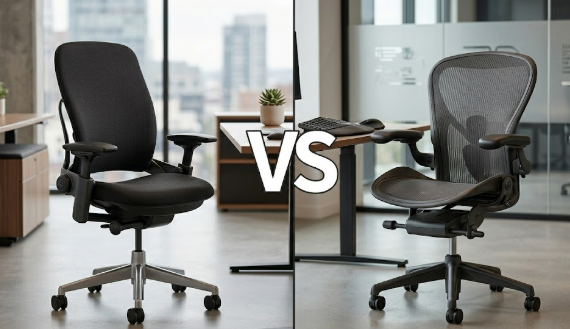
When the budget allows for a genuinely premium chair, the decision almost always comes down to two titans: the Herman Miller Aeron, the icon of mesh engineering, and the Steelcase Leap V2, the gold standard of mechanical adjustability. Both are exceptional, both carry a twelve-year warranty, and both will outlast a cheap office chair by a decade. But they are built on opposite philosophies, and for back pain specifically, the right choice depends far more on how you sit than on which brand you prefer.
This comparison breaks the two down across back support, seat comfort, breathability, adjustability, and value, with an honest look at who each one suits. If you want the wider field first, see our roundup of the best ergonomic chairs for back pain, and if you are also weighing the Aeron against its in-house rival, our Embody vs Aeron comparison covers that matchup.
The quick verdict
Choose the Steelcase Leap V2 if you sit for eight or more hours, shift positions frequently, lean back regularly, or want a chair that adapts to you with deep, adjustable lumbar support, it is the more frequently recommended chair in back-pain discussions and the safer bet for a wider range of bodies. Choose the Herman Miller Aeron if you tend to sit upright, you run hot and want unbeatable breathability, or you want firm, precise, structured support that holds you in one healthy posture. Neither can cure back pain, and there is no single winner; the better chair is the one that matches how you actually work.
Price and value
Both are premium investments, but the Leap is usually the more affordable of the two when bought new, often landing around a thousand dollars, while the Aeron typically sits higher, around $1,700 and up. Both are backed by twelve-year warranties and built to last, so the cost spreads to very little per day over a decade of use. Importantly, both are among the rare chairs genuinely worth buying certified-refurbished, where you can often save twenty to forty percent with the warranty intact, and a refurbished Leap in particular can be excellent value. If budget is the deciding factor, the Leap generally costs less for similar longevity.
Back support: the core difference
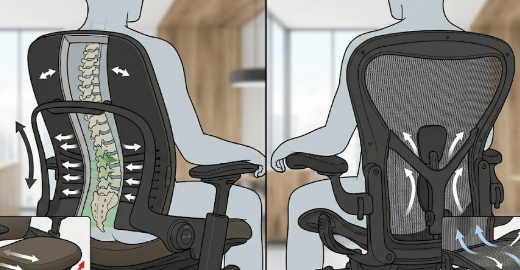
This is where the two diverge most, and it is the heart of the decision for back pain. The Aeron uses PostureFit SL, a dual-pad system that supports the sacrum and the lumbar region independently, gently propping your pelvis into a forward tilt to maintain the natural S-curve of your spine. It is firm and fixed: you set it once and it holds you in place, which is a genuine advantage if you know exactly where your back hurts and want precise, consistent support. The trade-off is that it is less forgiving if you like to sit cross-legged or lean to one side; in effect, you sit the way the chair wants you to sit.
The Leap V2 takes the opposite approach with its LiveBack technology. The backrest flexes with your spine, its upper and lower sections moving independently as you recline, lean, or shift your weight, so it maintains lumbar contact across changing positions rather than holding you in one. It also adds an adjustable lumbar pad with both height and firmness control, plus a gliding seat that moves with you as you recline. Because it adapts to more sitting positions, the Leap is the one more often recommended for people whose pain worsens when they move and lose support, and several sources note its LiveBack and deeper lumbar customization make it the stronger choice for sciatica, where maintaining neutral alignment matters; our guide to the best chairs for sciatica goes deeper on that.
Seat and comfort
The seats feel very different. The Aeron’s seat is the same 8Z Pellicle mesh as its back: firm, breathable, and pressure-distributing. Many people love how it feels, but some find it too hard after six or more hours. The Leap’s seat is padded foam with fabric upholstery, which most people find softer and more comfortable over very long sessions, at the cost of breathability. If long, marathon sitting is your reality and you prioritise cushioning, the Leap’s seat tends to win; if you dislike soft cushions and prefer a firm, suspended feel, the Aeron suits you better.
Breathability
This category goes decisively to the Aeron. Its full Pellicle mesh on both seat and back allows continuous airflow and keeps you noticeably cooler through the day, which is a real advantage in a warm room or climate. The Leap’s padded seat and back retain more heat. If overheating during long sessions is a genuine concern for you, the Aeron’s mesh is the clear pick.
Adjustability and fit
The Leap is the more mechanically adjustable chair, with adjustable lumbar height and firmness, seat depth, and a highly tunable recline, all in a single size that fits a wide range of bodies. The Aeron instead relies on coming in three sizes, A, B, and C, so you match the chair to your frame, plus its adjustable PostureFit SL and a smooth Harmonic tilt, though it lacks an adjustable lumbar height. In short, the Leap lets you fine-tune one chair around your body, while the Aeron lets you pick the size that fits and then dials in firm support. For people who like to tweak every setting, the Leap offers more control.
At-a-glance comparison
The table below summarises the main differences. Prices are approximate United States figures and can change, so always confirm current pricing before buying.
| Feature | Steelcase Leap V2 | Herman Miller Aeron |
|---|---|---|
| Approx. price (new) | ~$1,000 – $1,100 | ~$1,700+ |
| Back support | LiveBack, adapts as you move | PostureFit SL, firm & fixed |
| Seat | Padded foam, softer | Mesh, firm & breathable |
| Breathability | Lower (padded) | Excellent (full mesh) |
| Lumbar adjustment | Height + firmness | PostureFit SL (no height adj.) |
| Sizes | One size, wide adjustment | Three sizes (A, B, C) |
| Best for | Long hours, shifting posture, sciatica | Upright sitting, hot rooms, precise support |
Which should you buy?
Buy the Steelcase Leap V2 if you sit for eight or more hours a day, you shift positions and lean back often, you want deep adjustable lumbar support that follows your movements, comfort over long sessions is your top priority, or you are dealing with sciatica and want a chair that maintains neutral alignment. It is the technical adjustability champion and the more forgiving chair for varied bodies and postures. Buy the Herman Miller Aeron if you sit upright, you run hot and want the best breathability, you prefer firm support over cushioning, you want precise, set-and-forget support targeting a known problem area, or you simply love the iconic design. Because both are expensive and suit different people, testing each for fifteen to twenty minutes with the adjustments set for your body is the surest way to decide.
Whichever you choose, remember that no chair, however premium, replaces the rest of a healthy setup. Correct desk and monitor height, foot support, regular movement, and strengthening all matter as much as the seat. If the price of either is hard to justify, our guide to the best office chairs under $300 covers strong budget alternatives.
Frequently asked questions
Which is better for lower back pain, the Leap or the Aeron?
Both are excellent but address it differently. The Aeron’s PostureFit SL targets the root of much desk-related pain by preventing posterior pelvic tilt with firm sacral support, which many feel immediately. The Leap’s LiveBack maintains lumbar contact as you change position, which suits people whose pain worsens when they shift and lose support. The Leap is more often recommended in back-pain discussions because it adapts to more positions, but the best choice depends on your body and habits.
Which chair is better for sciatica?
The Steelcase Leap is generally considered the stronger choice for sciatica, thanks to its LiveBack technology and deeper lumbar customization, which help maintain neutral spinal alignment and reduce nerve compression during long sitting. That said, sciatica is a medical condition, so it is wise to consult a physiotherapist about your specific situation rather than relying on a chair alone.
Is the Aeron or the Leap better for long hours?
Many people prefer the Leap for very long sessions because of its padded seat and adaptive support, while those who run hot often prefer the Aeron’s breathable mesh. If marathon comfort and cushioning are your priority, lean Leap; if staying cool and firm support matter more, lean Aeron.
Are these chairs worth buying refurbished?
Yes. Both Herman Miller and Steelcase offer certified-refurbished chairs with full warranties, often restored to near-new condition at twenty to forty percent off retail. For budget-conscious buyers, a refurbished Leap or Aeron from a reputable dealer is one of the smartest ways to get proven, long-lasting ergonomic support for less.
The bottom line
The Steelcase Leap V2 and Herman Miller Aeron are both among the best chairs you can buy, and neither will let your back down if set up properly. The Leap is the adaptable, deeply adjustable choice for long hours, shifting posture, and sciatica, and it usually costs less; the Aeron is the firm, precise, breathable choice for upright sitters who run hot. Match the chair to how you work, test both if you can, and pair whichever you choose with movement and a good overall setup. For another premium matchup, see our Herman Miller Embody vs Aeron comparison.
Affiliate disclosure: This article contains affiliate links. If you buy a product through one of them, we may earn a small commission at no extra cost to you. This never influences which products we recommend.
Medical disclaimer: We are not doctors or physiotherapists, and this article is for general informational purposes only. It is not medical advice and should not replace consultation with a qualified healthcare professional. If you have persistent, severe, or worsening back pain, or a condition such as sciatica, please seek advice from a licensed medical provider.