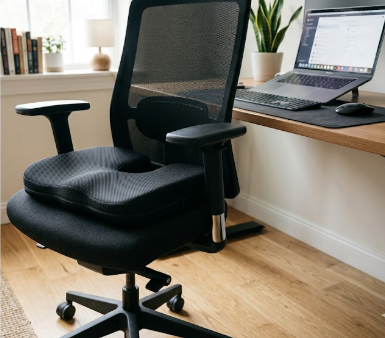
If sitting all day leaves your tailbone sore or your lower back aching, the surface you sit on may be doing more harm than you realise. On a hard or poorly padded seat, your coccyx and sit bones bear a disproportionate share of your body weight, which leads to pressure, discomfort, and a pelvis that tilts out of its healthy position. A good seat cushion spreads that weight evenly, relieves pressure on the tailbone, and helps keep your pelvis in a neutral position, which in turn supports the natural alignment of your spine above it.
A seat cushion works on the part of the equation a lumbar support cannot reach: what is underneath you rather than behind you. In this guide we cover the best seat cushions for back pain in 2026, explain the difference between coccyx, wedge, and gel designs, and help you pick the right one. For complete support, many people pair a seat cushion with one of the products in our best lumbar support guide.
How a seat cushion helps your back
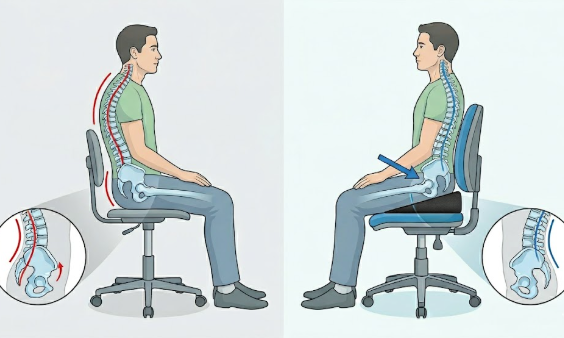
A seat cushion helps in two main ways. First, it relieves pressure: by distributing your body weight across the cushion rather than concentrating it on the tailbone and sit bones, it reduces the soreness and inflammation that build up during long sitting sessions. Second, it influences posture: a well-designed cushion encourages a neutral pelvic tilt, and when your pelvis sits correctly, the rest of your spine stacks more naturally above it. The most common problem a cushion addresses is tailbone pain, where the coccyx takes too much pressure on a hard seat, but the right cushion can also help with general lower-back discomfort by improving how you sit.
Types of seat cushion explained
Coccyx cushions feature a U-shaped cutout at the rear so the tailbone floats above the seat surface, eliminating direct pressure on it and letting weight rest on the surrounding muscles and thighs. This design is the go-to for tailbone soreness. Wedge cushions are higher at the back and lower at the front, which tilts the pelvis slightly forward and encourages a more upright posture; interestingly, when researchers compared wedge and donut designs for tailbone pain, people with a preference were far more likely to favour the wedge. Gel-enhanced cushions add a layer of gel over memory foam for cooler, more even pressure distribution, while donut cushions, the classic ring shape, are an older design that many now find less effective than a contoured wedge or coccyx cushion. Whichever style, high-density memory foam holds its shape and support far longer than cheap foam that quickly flattens.
The best seat cushions for back pain in 2026
Everlasting Comfort Memory Foam Seat Cushion — Best overall
The Everlasting Comfort seat cushion is a consistent top performer, combining supportive high-density memory foam with an ergonomic shape and a U-shaped coccyx cutout that takes pressure off the tailbone. It holds its form well over time, has a non-slip base and washable cover, and is available as a combo with a matching lumbar pillow, which makes it an easy way to support both your tailbone and your lower back at once. For most desk workers, it is the reliable, well-rounded choice.
ComfiLife Gel Enhanced Seat Cushion — Best value
The ComfiLife is one of the most popular seat cushions available and offers excellent value. It pairs high-density memory foam with a gel layer for cooler, even support, uses a coccyx cutout to relieve tailbone pressure, and includes a non-slip rubber bottom and a washable cover. It is lightweight and portable, often with a carry handle, so it moves easily between your office chair, car, and travel seats. For a quality cushion at an accessible price, it is hard to beat.
Cushion Lab Pressure Relief Seat Cushion — Best premium
For those who want a more advanced, durable option, the Cushion Lab seat cushion uses an extra-dense, ergonomically engineered foam designed to support heavier and longer sitting without bottoming out, paired with a contoured shape and coccyx relief. It costs more than mainstream cushions but offers superior structural integrity and support over years of daily use, and it pairs naturally with the brand’s lumbar pillow. You can see the design on the official Cushion Lab site.
A seat wedge cushion — Best for posture and pelvic tilt
If your main goal is to improve how you sit rather than to relieve a specific sore tailbone, a wedge cushion is an excellent choice. Its sloped shape tilts the pelvis gently forward into a more upright, neutral position, which can ease the slumping that contributes to lower-back strain. Many also include a coccyx cutout for added tailbone relief. It is a simple, affordable way to nudge your posture in the right direction on an otherwise flat seat.
A budget coccyx cushion — Best on a tight budget
If you simply want to try a seat cushion without spending much, there are many affordable orthopaedic coccyx cushions that deliver the core benefit, a contoured shape with a tailbone cutout, a non-slip base, and a washable cover, at a low price. They may not match the premium foam density or longevity of higher-end options, but as a low-risk way to find out whether a cushion helps you, a budget pick is a sensible starting point.
At-a-glance comparison
The table below summarises the picks above. Prices are approximate United States figures and can change, so always confirm current pricing before buying.
| Cushion | Best for | Design | Approx. price |
|---|---|---|---|
| Everlasting Comfort | Overall | Memory foam, coccyx cutout | ~$30 – $40 |
| ComfiLife Gel Enhanced | Value | Gel + memory foam, coccyx cutout | ~$30 |
| Cushion Lab Pressure Relief | Premium | Extra-dense foam, contoured | ~$70 – $100 |
| Seat wedge | Posture & pelvic tilt | Sloped wedge | ~$25 – $40 |
| Budget coccyx cushion | Tight budget | Foam, coccyx cutout | ~$20 |
How to choose and use a seat cushion
Start by matching the design to your problem: choose a coccyx cushion with a U-shaped cutout if your tailbone is sore, a wedge if your main concern is posture and slumping, and a gel-enhanced cushion if you tend to get warm during long sits. Prioritise high-density foam, which keeps its support far longer than cheap padding, and look for a non-slip base and a washable cover. To use it well, sit fully back so your hips are supported and your weight rests correctly on the cushion, and combine it with a lumbar support if you also need lower-back contact, since the two address different areas. A cushion supports you on almost any chair, at your desk, in the car, or while travelling, so you keep the benefit wherever you sit.
As with every accessory, a cushion is a supportive aid, not a substitute for movement. Use it alongside regular breaks and a few back pain exercises for remote workers, and if your chair offers no support at all, consider an upgrade from our best ergonomic chairs guide. The NHS overview of managing back pain is a useful companion read.
Frequently asked questions
Do seat cushions really help with back pain?
They can help by distributing your weight more evenly, relieving pressure on the tailbone and sit bones, and encouraging a more neutral pelvic position, which supports better posture. They are particularly effective for tailbone soreness from hard seats. A cushion is a comfort and support aid rather than a medical treatment, and it works best alongside movement and a good overall setup. Persistent or severe pain should be assessed by a professional.
Wedge cushion or coccyx cushion: which should I choose?
Choose a coccyx cushion with a rear cutout if your main issue is a sore or pressured tailbone, since it lets the coccyx float free of the seat. Choose a wedge if your priority is posture, because its slope tilts the pelvis forward into a more upright position. Many cushions combine both ideas, and some people use a wedge with a coccyx cutout for both benefits.
Is a donut cushion good for back pain?
Donut cushions are an older ring-shaped design, and while some people like them, research comparing them with wedge cushions for tailbone pain found that people with a preference tended to favour the wedge. For most desk workers, a contoured coccyx or wedge cushion made of high-density foam is a more effective modern choice.
Can I use a seat cushion and a lumbar support together?
Yes, and many people do, because they address different areas: the seat cushion supports what is underneath you, relieving tailbone and sit-bone pressure, while a lumbar support fills the curve behind your lower back. Used together they provide more complete support, and some brands sell them as a matching combo.
The bottom line
A seat cushion is an inexpensive, portable way to make long sitting kinder to your tailbone and lower back. The Everlasting Comfort cushion is the best all-round choice, the ComfiLife is the value pick, and a wedge is ideal if posture is your main concern. Match the design to your problem, choose high-density foam, and pair it with movement and, if needed, a lumbar support for complete coverage.
Affiliate disclosure: This article contains affiliate links. If you buy a product through one of them, we may earn a small commission at no extra cost to you. This never influences which products we recommend.
Medical disclaimer: We are not doctors or physiotherapists, and this article is for general informational purposes only. It is not medical advice and should not replace consultation with a qualified healthcare professional. If you have persistent, severe, or worsening back or tailbone pain, please seek advice from a licensed medical provider.