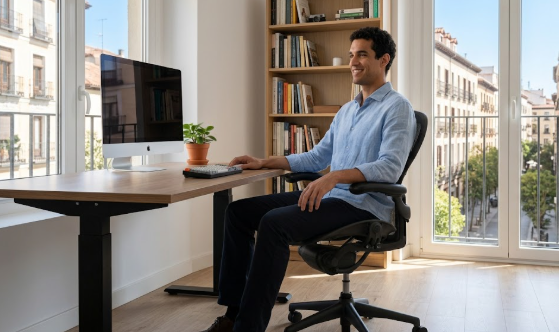
If you are tall, you already know that most office chairs were not built with you in mind. The average chair is designed for people somewhere between five foot four and five foot eleven, which leaves taller users with a seat that is too shallow to support the thighs, a backrest that stops short of the shoulders, and a seat that does not rise high enough to keep the knees at a comfortable angle. The result is slouching, reduced circulation in the legs, neck tension, and a steady ache in the back, none of which is your posture’s fault. It is a fit problem, and the fix is a chair sized for your frame.
This guide covers the best ergonomic chairs for tall people in 2026, explains the measurements that actually matter when you are above average height, and includes options for both tall-and-slim and big-and-tall builds. If you want the wider field, our roundup of the best ergonomic chairs for back pain covers every body type, and at the opposite end, our guide to chairs for petite and short people tackles the reverse problem.
What tall users need in a chair
A few specifications matter far more when you are tall. Seat height is the first: a standard chair tops out around eighteen inches, but tall users often need it to rise to roughly twenty-one to twenty-three inches so the feet rest flat with the knees at a right angle, which sometimes means choosing a model offered with a taller gas cylinder. Seat depth is just as important, because a deeper seat, often twenty inches or more, supports the full length of your thighs instead of leaving them hanging off the front edge. A tall backrest, ideally around thirty inches or paired with an adjustable headrest, supports the upper back and neck rather than ending mid-spine. Add four-dimensional armrests that rise high enough for your longer arms, and a weight capacity that comfortably exceeds your weight, and you have the recipe for a chair that fits rather than fights you.
The best ergonomic chairs for tall people in 2026
Herman Miller Aeron, Size C — Best premium for tall users
One of the Aeron’s great advantages is that it comes in three sizes, and the largest, Size C, is built specifically for taller and larger users, comfortably accommodating people up to around six foot six. You get the same breathable 8Z Pellicle mesh and adjustable PostureFit SL lumbar and sacral support as the standard Aeron, scaled up so the seat and back actually fit a bigger frame. Backed by a twelve-year warranty and built to last well over a decade, it is the premium choice for tall users who want size-specific support without compromise, and it also has a strong refurbished market if you want to save. You can confirm sizing on the official Aeron product page.
Steelcase Leap V2 — Best overall for tall users with back pain
The Steelcase Leap V2 fits an unusually wide range of body types, and reviewers as tall as six foot two consistently praise its comfort, thanks to one of the best adjustable lumbar systems in the business and a generous range of seat depth, height, and arm adjustment. It is our go-to recommendation for tall people whose main concern is back pain. One small thing to know: when you slide the seat all the way out for maximum depth, a gap can form between the seat and backrest, which is a minor nuisance rather than a dealbreaker. Like the Aeron, it is one of the few chairs genuinely worth buying refurbished, where you can get it for considerably less. See it on the official Steelcase site.
Steelcase Gesture — Best for very tall and arm support
The Steelcase Gesture is another excellent fit for taller users, with generous adjustability and arms that move through an exceptional range to support longer limbs in almost any posture, from leaning back to working on a device. Its supportive backrest and solid build make it a strong choice for tall people who want premium comfort and the most flexible armrests in the category. It sits in the same premium bracket as the Leap and is similarly built to last.
Autonomous ErgoChair Pro — Best value with a headrest
For tall users who want a headrest and plenty of adjustability without a premium price, the Autonomous ErgoChair Pro is a strong mid-range pick. It offers an adjustable headrest to support the neck, a reclining backrest, adjustable lumbar support, and 4D armrests, which together suit a taller frame well within its roughly 300-pound weight range. Note that its seat width is standard rather than oversized, so it is better for tall-and-slim builds than for those who also need a wider seat. For most tall remote workers on a budget, it offers premium-style features at an accessible cost.
A heavy-duty big-and-tall chair — Best for higher weight capacities
If you are big as well as tall and need a higher weight capacity, look to a dedicated big-and-tall chair rated to 350 or 400 pounds, with a wider, deeper seat and a reinforced base. Models in this category typically feature an S-shaped high backrest, adjustable lumbar support, and a sturdy frame designed for larger users, often with breathable mesh or perforated upholstery to prevent overheating. These chairs tend to be large and heavy, so they suit a roomier workspace, but for users who need genuine heavy-duty support, they provide stability and comfort that standard chairs cannot.
At-a-glance comparison
The table below summarises the picks above. Prices are approximate United States figures and can change, so always confirm current pricing before buying.
| Chair | Best for | Key tall-friendly feature | Approx. price |
|---|---|---|---|
| Herman Miller Aeron (Size C) | Premium | Largest size, fits up to ~6’6″ | ~$1,800+ |
| Steelcase Leap V2 | Overall / back pain | Wide fit range, top lumbar | ~$650 (refurb) – $1,100 |
| Steelcase Gesture | Very tall & arm support | Exceptional armrest range | ~$1,000+ |
| Autonomous ErgoChair Pro | Value with headrest | Headrest + 4D arms | ~$350 |
| Big-and-tall chair | Higher weight capacity | 350–400 lb, wider seat | ~$300 – $450 |
How to set up a chair if you are tall
Even the right chair needs adjusting. Raise the seat so your feet rest flat and your knees sit at roughly a right angle, then set the seat depth so the full length of your thighs is supported with a small gap behind the knees. Position the lumbar support to fill the curve of your lower back, raise the armrests so your shoulders stay relaxed, and adjust any headrest to cradle the base of your skull rather than push your head forward. If your chair rises high enough for comfortable typing but that leaves your feet dangling, a footrest restores the supported position, which is exactly what we cover in our best office footrests guide.
If you cannot upgrade right away, a few stopgaps help: a seat cushion can raise your sitting height, a footrest can correct your leg angle, and a lumbar cushion can reposition your back support. These are genuine temporary improvements, but for a tall frame they are no match for a chair actually built for your height, which over time is far more effective for your back and neck.
Frequently asked questions
What seat height do tall people need?
Many tall users need a seat that rises to roughly twenty-one to twenty-three inches, compared with the standard eighteen inches, so their feet rest flat with the knees at a right angle. Some premium chairs offer a taller gas cylinder option specifically for this. Check the chair’s maximum seat height against your own measurements before buying.
Is the Herman Miller Aeron good for tall people?
Yes, provided you choose the right size. The Aeron comes in three sizes, and the largest, Size C, is designed for taller and larger users, accommodating people up to around six foot six. Choosing the correct size is essential, since the mid size can feel too small for taller frames, so do not assume the standard size will fit.
What is the difference between a tall chair and a big-and-tall chair?
A chair suited to tall users prioritises seat height, seat depth, a high backrest, and often a headrest to fit a longer frame, and most accommodate weights up to around 300 pounds. A big-and-tall chair adds a higher weight capacity, often 350 to 400 pounds, and a wider seat and reinforced base for larger builds. If you are tall and slim, a standard premium chair in the right size works well; if you are also heavier, choose a dedicated big-and-tall model.
Can a footrest help if my chair is too high?
Yes. If you set your chair high enough to type comfortably but your feet no longer reach the floor, a footrest restores the supported position and stops your pelvis tilting, which protects your lower back. It is a simple, inexpensive fix and a useful companion to a tall-friendly chair.
The bottom line
For tall people, the right chair is about fit, not luck, and getting it right transforms how your back and neck feel after a long day. The Herman Miller Aeron in Size C is the premium choice, the Steelcase Leap V2 is the best all-rounder for tall back-pain sufferers, and a dedicated big-and-tall model is the answer if you need a higher weight capacity. Match the seat height, depth, and backrest to your frame, set everything up correctly, and add a footrest if needed. If your budget is tighter, our guide to the best office chairs under $300 includes options that still offer the adjustability tall users need.
Affiliate disclosure: This article contains affiliate links. If you buy a product through one of them, we may earn a small commission at no extra cost to you. This never influences which products we recommend.
Medical disclaimer: We are not doctors or physiotherapists, and this article is for general informational purposes only. It is not medical advice and should not replace consultation with a qualified healthcare professional. If you have persistent, severe, or worsening back pain, please seek advice from a licensed medical provider.