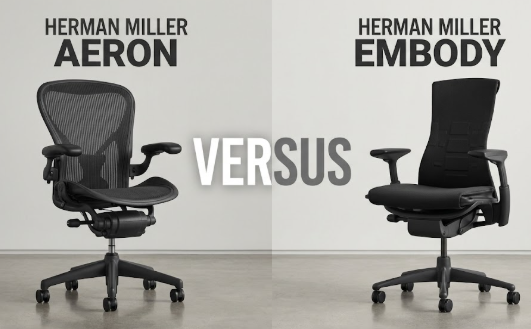
If you are spending serious money on a chair to save your back, two Herman Miller icons almost always end up on the shortlist: the Aeron, the mesh classic that helped invent the modern ergonomic chair, and the Embody, the pixelated, dynamic newcomer built around movement. Both are exceptional, both ship fully assembled, both carry a twelve-year warranty, and both can genuinely help with back pain. But they take opposite approaches to supporting your spine, and the right one depends on how you sit and what your back actually needs.
This comparison breaks the two down across price, back support, seat comfort, breathability, adjustability, recline, and build, with an honest look at where reviewers disagree. If you want to see how these two stack up against the wider field first, our roundup of the best ergonomic chairs for back pain covers options across every budget, and our Aeron vs Secretlab Titan comparison pits the Aeron against a very different rival.
The quick verdict
Choose the Embody if you want dynamic, adaptive support that flexes as you shift position, a more cushioned seat, and all-round comfort over very long hours, especially if you tend to change posture a lot through the day. Choose the Aeron if you want firm, structured, almost foolproof lower-back and sacral support, the best breathability for warm rooms, a precise size match, and what many consider the better recline and armrests. Neither is objectively “the best for back pain”; they relieve it in different ways, and the honest answer is that the better chair is the one whose support style matches your body and habits.
Price and value
These are both premium investments, and they sit at a similar price point. The entry-level Aeron and the Embody both typically start somewhere around $1,700 to $1,900, with the Embody often a little higher and both climbing with options. At this level you are paying for materials and engineering designed to last well over a decade, and the twelve-year warranty on each spreads that cost across many years of daily use. One practical difference worth knowing: the Aeron has a huge secondhand and certified-refurbished market, so remastered units often turn up at a fraction of the new price, whereas the Embody is more commonly bought new. If buying used is on the table, that can tilt the value equation toward the Aeron.
Back support: the most important difference
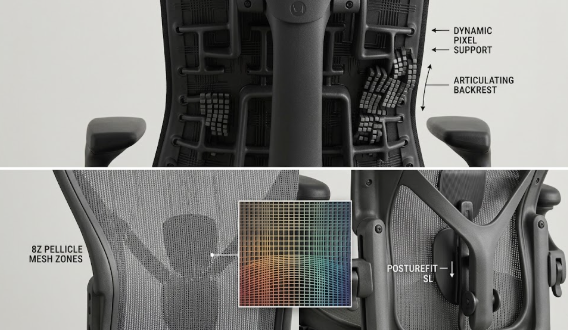
This is where the two chairs genuinely diverge, and it is the heart of the decision for anyone with back pain. The Aeron uses its PostureFit SL system, which provides targeted, adjustable support to the lower back and the sacrum at the base of the spine, encouraging the natural S-curve and holding you in a stable, upright posture. Combined with the tensioned 8Z Pellicle mesh, it tends to feel firm and structured, and many users describe it as almost foolproof: you tuck your hips into the seat, plant your feet, and the chair holds your posture with little conscious effort. Its forward-tilt function is something some lower-back sufferers credit specifically with easing their pain.
The Embody takes the opposite philosophy. Instead of targeted pads, its Backfit system uses a matrix of flexible “pixels” across the backrest that flex and move with you, mechanically adjusting the whole backrest to support your spine’s alignment as you shift position rather than pinning you to one spot. Reviewers often note it cups the upper and mid-back especially well, and because its lumbar support is integrated into that dynamic design rather than separately adjustable, it suits people who want constant, mobile support that adapts to changing postures. For those who fidget and change position constantly, that backrest flexibility is something the Aeron simply cannot match, which is why the Embody is frequently recommended for people who want adaptive support over long, varied sessions.
Seat and comfort
The seats feel quite different. The Aeron’s mesh seat distributes weight and breathes superbly, but because it is a firm, tensioned surface, some people find it creates pressure points on the thighs or tailbone during very long sitting sessions. The Embody’s pixelated, upholstered seat adds cushioning and distributes pressure across its flexible surface, which many find more forgiving over a full workday, though it is worth knowing that even the Embody seat is on the firm side rather than plush, and it is narrower in profile. If tailbone or thigh pressure on mesh has bothered you before, the Embody’s seat may suit you better, though adding a contoured cushion from our best seat cushions guide can also solve that on either chair.
Breathability
If you run warm or live in a hot climate, this category goes decisively to the Aeron. Its full suspension mesh on both seat and back allows air to flow freely, keeping you cool through long sessions. The Embody’s foam-and-fabric seat, by contrast, retains more heat and is noticeably less breathable. For many desk workers this is a minor point, but if overheating is a real problem for you, the Aeron’s mesh is a meaningful advantage.
Adjustability and fit
The two chairs handle fit differently. The Aeron comes in three sizes, A, B, and C, so you match the chair to your body rather than adjusting one universal frame, which gives an excellent tailored fit but means you must choose the right size; larger users in particular should look closely at size C, as some find the mid size too small. The Embody comes in a single size with a wide adjustment range and its Backfit and seat-depth controls, which makes it more accommodating of different bodies sharing one chair, though it lacks the size-specific precision of the Aeron. Both let you adjust arms, tilt, and seat depth, with the Aeron offering more discrete, separately adjustable settings overall.
Recline, armrests and build
Both chairs are beautifully built and arrive fully assembled, and both are backed by a twelve-year warranty. In day-to-day feel, many reviewers give the Aeron the edge on recline, often calling it the best in its class, and praise its armrest pads, while a few Embody owners report the armrests can feel less solid or rattle over time. The Embody’s standout is its backrest flexibility, which the Aeron cannot replicate. In short, the Aeron leans toward refined, structured stability, and the Embody toward dynamic, flexible movement, and both are built to last for many years.
At-a-glance comparison
The table below summarises the main differences. Prices are approximate United States figures and can change, so always confirm current pricing before buying.
| Feature | Herman Miller Embody | Herman Miller Aeron |
|---|---|---|
| Approx. price | ~$1,800+ | ~$1,700+ |
| Back support | Dynamic Backfit, flexes with you | PostureFit SL, targeted & firm |
| Seat | Cushioned pixel seat (still firm) | Tensioned mesh, breathable |
| Breathability | Lower (foam & fabric) | Excellent (full mesh) |
| Sizes | One size, wide adjustment | Three sizes (A, B, C) |
| Recline & arms | Good; arms can feel less solid | Class-leading recline & arm pads |
| Best for | Adaptive support & shifting posture | Firm structured support & airflow |
| Warranty | 12 years | 12 years |
Which should you buy?
Choose the Embody if you change position frequently, want a backrest that moves and adapts with you, prefer a more cushioned seat, and prioritise all-round comfort over a long, varied workday. It is the chair many reviewers now lean toward for everyday comfort, and a strong pick for people who never feel settled in a rigid seat. Choose the Aeron if you want firm, consistent lower-back and sacral support that holds your posture with minimal effort, you value breathability and a precise size match, or you make heavy use of recline; its forward tilt has also won over some lower-back sufferers specifically. If you cannot decide, it is worth knowing that both are genuinely excellent and you are unlikely to regret either, and trying them in person is the surest way to feel the difference.
Whichever you pick, remember that no chair, however premium, is meant to be sat in motionless all day. Pairing a Herman Miller chair with a height-adjustable desk so you can alternate between sitting and standing is one of the best things you can do for your back, as covered in our best standing desks guide. You can review full specifications on Herman Miller’s official Aeron vs Embody comparison and the official Aeron product page.
Frequently asked questions
Which Herman Miller chair is better for back pain, the Embody or the Aeron?
Both are excellent for back pain, but they help in different ways. The Embody’s dynamic backrest flexes and adapts as you move, which suits people who shift position often and want mobile, adaptive support. The Aeron’s PostureFit SL gives firm, targeted lower-back and sacral support that holds a stable upright posture with little effort. The Embody is often favoured for adaptive long-hours comfort, while the Aeron is favoured for firm, foolproof structured support.
Is the Embody seat more comfortable than the Aeron’s?
Many people find the Embody’s cushioned pixel seat more forgiving over a long day than the Aeron’s firm mesh, which can create thigh or tailbone pressure points for some. That said, the Embody seat is still firm rather than plush, and the Aeron’s mesh is far more breathable. If pressure has bothered you on mesh, the Embody may suit you better, or you can add a contoured seat cushion to either chair.
Are these chairs worth the high price?
For people who sit for many hours daily and value ergonomics and durability, they can be, because both are built to last well over a decade and carry a twelve-year warranty, which spreads the cost over many years. If the price is hard to justify, the Aeron’s strong refurbished market offers a way to get one for considerably less, and there are excellent lower-cost chairs in our best ergonomic chairs guide.
Which is better if I run hot?
The Aeron, clearly. Its full suspension mesh on both the seat and back breathes far better than the Embody’s foam-and-fabric seat, which retains more heat. If overheating during long sessions is a real concern for you, the Aeron’s airflow is a decisive advantage.
The bottom line
The Embody and the Aeron are two of the best chairs money can buy, and both will look after your back if set up correctly. The difference comes down to philosophy: the Embody supports you dynamically, flexing as you move and cushioning long, varied days, while the Aeron supports you firmly and consistently, with unbeatable breathability and a tailored size fit. Match the chair to how you sit, set it up properly, pair it with movement and a standing desk, and you will have a seat that serves your back for years. For more options and the full buying guide, see our best ergonomic chairs for back pain.
Affiliate disclosure: This article contains affiliate links. If you buy a product through one of them, we may earn a small commission at no extra cost to you. This never influences which products we recommend.
Medical disclaimer: We are not doctors or physiotherapists, and this article is for general informational purposes only. It is not medical advice and should not replace consultation with a qualified healthcare professional. If you have persistent, severe, or worsening back pain, please seek advice from a licensed medical provider.