
By mid-afternoon, many desk workers feel it: a tight, aching band across the top of the shoulders and a stiff, sore neck. The cause is usually the same forward-head, rounded-shoulder posture we all drift into while staring at a screen, sometimes called “tech neck.” Over hours, that posture creates a predictable muscle imbalance: the muscles at the front of the chest and neck get tight, the muscles at the back of the neck and upper back get weak, and the upper trapezius and the muscle running to your shoulder blade become chronically overloaded. A few minutes of the right stretches, done gently and regularly, can ease that tension and, over time, help your posture feel better.
This guide offers a simple neck and shoulder routine designed for desk workers, along with clear guidance on doing it safely. Please read the safety note first, because these stretches should feel like relief, never pain. They pair well with the whole-body movements in our back pain exercises for remote workers guide.
Important: how to stretch safely
Move gently and start with small, easy ranges rather than forcing anything, because your muscles respond better to relaxed, controlled motion than to an aggressive pull. It is normal to feel a gentle stretch, but none of these movements should cause pain; if a stretch increases your symptoms during or after, ease off, reduce the range, or simply do some slow breathing and gentle motion instead. Avoid long painful holds and aggressive self-cracking of the neck. And stop and seek prompt medical advice, rather than stretching, if you have any red-flag symptoms: numbness, tingling, or weakness travelling into your arm or hand, pain spreading down the arm, dizziness when you move your neck, severe pain after a fall or accident, or a fever with severe neck pain. Those can signal issues that need a professional, not a stretch session. If you have an existing injury or condition, check with a doctor or physiotherapist before starting.
The principle: stretch what’s tight, strengthen what’s weak
The most effective approach for desk-related neck and shoulder tension is to loosen the muscles that have shortened, mainly the chest and the upper trapezius, while gently activating the ones that have weakened, the deep neck flexors and the muscles that draw the shoulder blades back and down. That is why the routine below mixes a few gentle stretches with a couple of light strengthening moves. Together they counter the specific imbalance that desk work creates, which lasts longer than stretching alone.
The routine
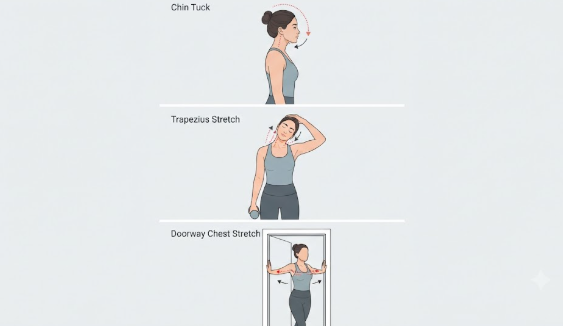
Chin tucks
This is the single most useful move for forward-head posture. Sit or stand tall, look straight ahead, and gently draw your chin straight back, as if making a “double chin,” without tilting your head up or down. You should feel a gentle lengthening at the back of the neck. Hold for around five seconds, then relax, and repeat about ten times. Keep the effort light; this trains the deep neck muscles that support your head.
Upper trapezius stretch
Sitting upright, slowly drop your right ear toward your right shoulder until you feel a gentle stretch down the left side of your neck. For a little more, rest your right hand lightly on the left side of your head, without pulling hard. Hold for about twenty to thirty seconds, then switch sides. This releases the muscle that carries much of the day’s shoulder tension.
Levator scapulae stretch
To target the muscle that connects your neck to your shoulder blade, a common source of that knot where the neck meets the shoulder, turn your head about forty-five degrees to the right and then tilt your chin down toward your armpit until you feel a stretch on the left side of the back of your neck. A gentle hand rest can deepen it slightly. Hold for twenty to thirty seconds and switch sides.
Gentle neck rotation
Sitting tall, slowly turn your head to one side as far as is comfortable, feeling an easy stretch, and hold for ten to fifteen seconds before returning to centre and turning the other way. Repeat a few times each side. This restores the rotation that stiffens up when you hold your head still for hours, and it should feel smooth and pain-free throughout.
Doorway chest stretch
Tight chest muscles pull your shoulders forward, and it is nearly impossible to hold your neck well when they do, so opening the chest is key. Stand in a doorway with your arms raised, elbows at about shoulder height and forearms resting against the door frame, then step forward gently from the hips until you feel a stretch across the front of your chest. Hold for about thirty seconds and repeat two or three times.
Shoulder blade squeezes
This gentle strengthening move helps your stretches last. With your arms by your sides, gently draw your shoulder blades back and down, not up toward your ears, hold for a couple of seconds, then relax, and repeat six to ten times. A common mistake is squeezing so hard that your shoulders shrug and your neck tenses; keep it light and think “heavy, relaxed shoulders” while the mid-back does the work.
Shoulder rolls and a breath
To finish, take a slow breath in as you roll your shoulders backward in a smooth circle, then exhale as you bring them down, repeating several times. Add a few slow breaths, inhaling for about four seconds and exhaling for six, letting your shoulders fully relax. Calming the nervous system this way helps release tension that pure stretching can miss.
How often to do it
Consistency matters more than intensity. A short round of this routine once or twice a day is more effective, and more sustainable, than an occasional long session, and many people find that setting a reminder twice a day works better than trying to stretch every half hour. You can also break the moves up and use them as active breaks through the workday, since research on computer-related neck pain suggests that regularly moving your neck and shoulders while you work is genuinely beneficial. The whole routine takes only about five to ten minutes.
What stretches alone cannot fix
Here is the honest part: no amount of stretching will save your neck if your desk setup keeps recreating the problem and you never take breaks. If you return to the same forward-head posture for eight hours, the tension comes back within hours. The biggest single fix is raising your screen so the top is at eye level, which stops your head craning forward, as covered in our guides to the best monitor stands and, for two screens, setting up dual monitors. Take a short walk and stand up regularly to unload your neck and shoulders, and give your neck a good recovery overnight with proper support, as our best cervical pillows guide explains. Stretching plus a good setup plus movement is what actually breaks the cycle.
Frequently asked questions
How often should I do neck and shoulder stretches?
Once or twice a day is a practical, effective target, and consistency matters more than doing a long session occasionally. You can also split the moves into short active breaks through the workday. Regularly moving your neck and shoulders while working is beneficial, so even brief, frequent movement helps more than a single big stretch.
Why does my neck hurt so much from desk work?
Prolonged sitting with a forward-head, rounded-shoulder posture overloads the muscles at the back of the neck and the top of the shoulders while tightening the chest, creating a muscle imbalance that leads to stiffness, aching, and sometimes headaches. Raising your screen, taking breaks, and doing targeted stretches and strengthening can all help reduce it over time.
Should stretching ever hurt?
No. A gentle stretching sensation is normal, but pain is not, and any movement that causes new or increasing discomfort should be stopped. If a stretch worsens your symptoms, ease off or switch to gentle motion and breathing, and if pain persists or you have red-flag symptoms like numbness or tingling into the arm, consult a healthcare professional.
Will stretches fix my posture permanently?
Stretching gives real short-term relief and, combined with light strengthening, can improve how your posture feels over time, but it is not a permanent fix on its own. Lasting improvement comes from pairing the routine with a good desk setup, especially a screen at eye level, and regular movement breaks, so the posture that caused the tension is not constantly recreated.
The bottom line
A few minutes of gentle neck and shoulder stretches, done consistently, can ease the tightness that builds up over a desk-bound day and, alongside light strengthening, help your posture feel better. Move gently, never into pain, watch for red-flag symptoms, and pair the routine with a screen at eye level and regular breaks so the tension does not simply return. For a full-body approach, add the moves in our back pain exercises for remote workers guide.
Medical disclaimer: We are not doctors or physiotherapists, and this article is for general informational purposes only. It is not medical advice, diagnosis, or treatment. These stretches are general suggestions and may not be suitable for everyone. Move gently and within a pain-free range, and stop immediately if you feel pain. Consult a qualified healthcare professional before starting if you have an injury, a diagnosed condition, or are pregnant, and seek prompt medical attention if you experience numbness, tingling, or weakness in the arm or hand, dizziness with neck movement, severe pain after an accident, or a fever with severe neck pain.