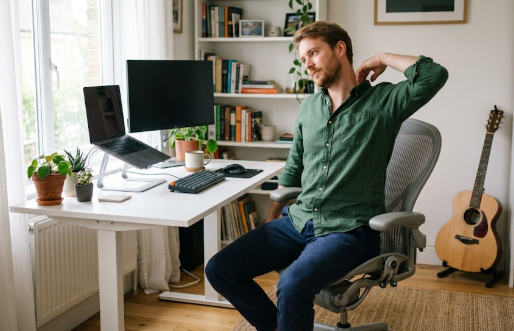
When you work from home, it is easy to go from your bed to your desk to your sofa without ever really moving, and your back pays the price. Sitting for hours steadily tightens the hip flexors, weakens the muscles that support your spine, and lets your posture collapse forward, which is why so many remote workers feel stiff and sore by mid-afternoon. The good news is that the remedy is mostly free: regular movement and a handful of simple stretches and strengthening exercises that take only a few minutes a day.
This guide walks through gentle, widely recommended exercises for desk workers, grouped into quick seated stretches, standing breaks, and a few floor moves you can do before or after work. None of them require equipment, and all of them are designed to fit around a normal working day. Pair them with a supportive setup from our best ergonomic chairs guide and our home office ergonomic setup guide, and your back has a real chance to feel better.
Before you start: a quick safety note
These exercises are general suggestions for healthy people, not a treatment programme for a specific condition. Move within a comfortable, pain-free range and stop immediately if anything causes sharp, shooting, or significantly increasing pain. It is normal for new movement to feel mildly unfamiliar at first, but it should not make your pain noticeably worse. If you have a diagnosed back problem, are recovering from an injury, are pregnant, or have any doubt about whether these are right for you, talk to your doctor or a physiotherapist first. The NHS offers a helpful overview of managing back pain that is worth reading alongside this guide.
The real fix: move more often
Before any specific stretch, the single most effective thing you can do is break up long periods of sitting. Prolonged stillness, not movement, is what loads your lower spine and stiffens your muscles. Aim to change position or get up for a minute or two every thirty to sixty minutes; a glass of water, a short walk to another room, or a few of the stretches below all count. A height-adjustable desk makes this far easier, which is why we cover the best standing desks for back pain separately, but you do not need any equipment to simply stand up more often. Think of the exercises here as ways to fill those micro-breaks rather than a single workout you do once and forget.
Seated stretches you can do at your desk
Seated pelvic tilts
Sitting tall with your feet flat on the floor, gently roll your pelvis forward to create a small arch in your lower back, then roll it backward to flatten the curve. Move slowly and smoothly between the two positions about ten times. This wakes up the lower back and reminds your body how to move the pelvis, which is often locked rigid after hours of sitting.
Seated spinal twist
Sitting upright, place one hand on the opposite knee and rest the other on the back of your chair, then gently rotate your torso to look over your shoulder. Keep the movement coming from your mid-back rather than wrenching your neck, hold for a few easy breaths, and return slowly before switching sides. This relieves the rotational stiffness that builds up when you sit facing one screen all day.
Seated figure-four stretch
Cross one ankle over the opposite knee so your bent leg makes a figure four, sit tall, and gently lean forward from the hips until you feel a comfortable stretch in the buttock and outer hip. Hold for twenty to thirty seconds and switch sides. Tight glutes and hips are a common hidden contributor to lower-back discomfort in people who sit a lot.
Neck release and chin tucks
For the neck tension that often accompanies back pain, gently draw your chin straight back to make a slight double chin, hold for a couple of seconds, and release, repeating several times. You can also tilt your ear gently toward each shoulder for a mild side-neck stretch. Keep these movements small and slow; the neck does not need force.
Shoulder blade squeezes
Sitting or standing tall, draw your shoulder blades gently down and back as if tucking them into your back pockets, hold for a few seconds, then relax. Repeat around ten times. This counteracts the rounded-forward posture of typing and helps support the upper back, which takes pressure off the spine lower down.
Standing breaks beside your desk
Gentle standing back extension
Stand with your feet shoulder-width apart and place your hands on your hips for support. Slowly and gently lean backward only as far as is comfortable, keeping the movement controlled, then return to upright. This counters the constant forward-bent position of desk work. Keep it small and pain-free; this is a gentle reset, not a deep backbend.
Standing hip flexor stretch
Step one foot forward into a short lunge with both feet pointing ahead, keep your torso upright, and gently tuck your pelvis under until you feel a stretch at the front of the hip of your back leg. Hold for twenty to thirty seconds and switch sides. Hours of sitting shorten the hip flexors, and loosening them often eases lower-back tightness.
Doorway chest stretch
Stand in a doorway, place your forearms on the frame with your elbows at about shoulder height, and step gently forward until you feel a stretch across your chest and the front of your shoulders. Hold for twenty to thirty seconds. Opening the chest helps reverse the hunched posture that pulls the upper back and neck out of alignment.
Standing forward fold
With your feet shoulder-width apart and knees softly bent, slowly roll forward and let your hands slide down your legs toward the floor until you feel a gentle stretch along the back of the legs and lower back. Hold briefly, then roll back up one vertebra at a time. Keep the knees bent if your hamstrings are tight, and never force it.
Floor exercises to build a stronger, more supportive back
These are best done before or after work, on a mat or carpet, when you have a few minutes. Strengthening the muscles around your spine and hips gives your back more durable support than stretching alone.
Knee-to-chest stretch
Lie on your back with your knees bent, then bring one knee up and gently hug it toward your chest with your hands, holding for twenty to thirty seconds before switching. You can also bring both knees up together. This is a soothing way to gently mobilise the lower back.
Knee rolls
Lying on your back with knees bent and feet flat, keep your shoulders on the floor and slowly let both knees drop to one side, then roll them to the other side. Move at a comfortable pace for about thirty seconds. This gently rotates and releases the lower spine.
Glute bridge
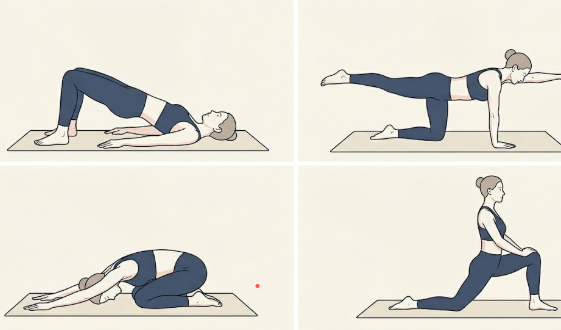
Lying on your back with knees bent and feet flat, tighten your lower abdominals and squeeze your glutes as you lift your hips into a gentle bridge, then lower slowly. Repeat for a few sets of eight to ten. This strengthens the glutes and posterior chain that support the lower back and are often underused in sedentary work.
Bird-dog
On your hands and knees with a flat back, slowly extend one arm forward and the opposite leg back until they are level with your body, hold briefly, then return with control and switch sides. Keep your core gently braced so your back does not sag. This builds the deep stabilising muscles that protect the spine during everyday movement.
Gentle prone press-up
Lie face down and place your hands flat under your shoulders, then gently press your chest up while keeping your hips on the floor, going only as far as is comfortable before lowering down. Repeat slowly a few times. Many people find gentle extension a welcome counter to a day spent flexed forward, but keep it pain-free and skip it if it aggravates your symptoms.
Child’s pose
From hands and knees, sit your hips back toward your heels and reach your arms forward, letting your back gently lengthen, and breathe slowly for several breaths. It is a calming way to finish, releasing the lower back and decompressing after sitting.
Adding a foam roller
If you want to go a step further, a foam roller is an inexpensive tool for releasing tight muscles in the upper back, glutes, and legs that contribute to back discomfort. Used gently, it can complement the stretches above. We cover technique and the common mistakes to avoid in our dedicated foam roller for back pain guide, and if you struggle to keep an upright posture while working, a posture corrector may also help as a reminder.
A simple daily routine
You do not need to do everything every day. A realistic approach is to scatter the seated stretches through your workday whenever you stand up, add one or two standing stretches mid-morning and mid-afternoon, and do a short floor sequence of knee-to-chest, glute bridge, bird-dog, and child’s pose a few times a week. Consistency matters far more than intensity. A few minutes most days will do more for your back over time than an occasional long session, and improvements are usually gradual rather than instant.
Frequently asked questions
How often should I do these exercises?
The seated and standing stretches are designed to be done little and often throughout the workday, ideally every time you take a break from sitting. The floor strengthening moves are better suited to a few focused sessions a week. Listen to your body, build up gradually, and aim for regularity rather than intensity.
What if an exercise makes my pain worse?
Mild, short-lived muscle soreness as you get used to new movement is common, but sharp, shooting, or clearly worsening pain is a signal to stop that exercise. Reduce the range of movement or the number of repetitions, and if symptoms persist or worsen, speak to your doctor or a physiotherapist before continuing.
Can exercises alone fix back pain from sitting?
Movement and strengthening help a great deal, but they work best alongside a good setup and healthy habits. A supportive chair, a correctly arranged desk, regular breaks, and overall activity all contribute. Exercises are a key part of the picture, not a standalone cure, and persistent pain deserves professional assessment.
Is walking good for back pain?
Yes. Gentle activities like walking are among the most recommended things you can do, because they keep the spine moving, improve circulation, and counter the effects of prolonged sitting. Building short walks into your day is a simple and effective complement to the stretches here.
The bottom line
You do not need a gym or special equipment to look after your back as a remote worker; you need to move more often and spend a few minutes a day on simple stretches and strengthening. Break up your sitting, scatter the seated and standing stretches through your day, add a short floor routine a few times a week, and keep everything within a comfortable range. Combine that with a supportive workspace from our best ergonomic chairs for back pain guide, and you give your back the daily care it needs.
Medical disclaimer: We are not doctors, physiotherapists, or qualified exercise professionals, and this article is for general informational purposes only. It does not constitute medical advice, diagnosis, or a treatment plan, and the exercises described may not be suitable for everyone. Always work within a pain-free range, stop any movement that causes sharp or worsening pain, and consult a qualified healthcare professional before starting a new exercise routine, especially if you have an existing injury or medical condition, are pregnant, or experience persistent, severe, or worsening back pain.