Best TENS Unit for Lower Back Pain 2026: Honest Reviews and Usage Guide

Last updated: June 2026

Transparency: Some links in this article are affiliate links. If you purchase through them, we may earn a commission at no extra cost to you. This does not affect our rankings or recommendations.

Medical disclaimer: TENS therapy is a tool for temporary pain relief and is not a treatment for underlying conditions. This article is for informational purposes only and does not constitute medical advice. If you experience severe, persistent, or worsening back pain, or pain accompanied by numbness, tingling, leg weakness, or loss of bladder or bowel control, consult a licensed physician immediately before using a TENS unit. TENS units should not be used by people with pacemakers, implanted defibrillators, or epilepsy, during pregnancy, or over areas of reduced skin sensation. Always consult a healthcare professional if you are unsure whether TENS therapy is appropriate for your situation.

TENS — Transcutaneous Electrical Nerve Stimulation — is one of the most widely used non-pharmacological pain management tools in physical therapy, and it is now available to home users at prices ranging from $25 to $200. Millions of people with lower back pain use TENS units as part of their pain management routine, and the evidence base for their effectiveness at providing temporary relief is well established.

What the evidence does not support — and what this article will be honest about from the beginning — is the idea that a TENS unit treats the underlying cause of back pain. TENS provides temporary pain relief through two established mechanisms, but it does not repair disc damage, reduce inflammation at its source, or correct posture. It is a management tool, not a cure, and works best as one component of a broader approach that includes appropriate physical therapy, ergonomic setup, and regular movement.

With that context established, this guide reviews the best TENS units for lower back pain available in 2026, explains how to use them correctly, and covers electrode placement for the lumbar spine specifically.


How TENS works for lower back pain

TENS devices deliver low-voltage electrical impulses through electrode pads placed on the skin. These impulses affect pain through two primary mechanisms that are supported by published research.

The first is the gate control theory of pain, proposed by Melzack and Wall in 1965 and refined extensively since. The theory holds that the spinal cord has a “gate” that controls whether pain signals from the body reach the brain. High-frequency TENS (80–150 Hz) activates large-diameter nerve fibers that effectively “close the gate” to lower back pain signals, preventing them from reaching the brain. The pain relief is fast — often within minutes — but is temporary and does not persist long after the session ends.

The second mechanism is endorphin release. Low-frequency TENS (1–10 Hz) stimulates the production of endorphins — the body’s natural pain-relieving compounds — in a mechanism similar to acupuncture. This produces a longer-lasting relief effect than high-frequency TENS but takes longer to develop (typically 30 minutes or more into a session).

Most TENS units sold for home use operate primarily at higher frequencies (conventional TENS) with several preset modes that vary between frequency ranges. The different “modes” on consumer TENS units — burst, modulation, normal — are variations on these two mechanisms designed to prevent nerve accommodation (the tendency of nerves to adapt to a constant signal and reduce their response).


What TENS does not do

Being clear about this matters because many TENS unit listings on Amazon imply the devices “treat” herniated discs, sciatica, or degenerative disc disease. TENS provides temporary analgesia — pain signal reduction — during and for a period after the session. It does not reduce disc herniation, decompress a nerve root, or address any structural spinal pathology. For people with diagnosed structural conditions, TENS can be a useful adjunct to reduce pain during daily activities, but it should be used as part of a treatment plan developed with a healthcare provider, not as a substitute for it.

For the typical remote worker or office worker whose lower back pain is primarily muscular, postural, or from prolonged sitting, TENS is more appropriate: the pain has a muscular and neurological component that TENS addresses directly, without structural pathology that would require other intervention.


Quick picks

Best overall for home use: TENS 7000 — the physical therapist-recommended standard for over-the-counter TENS, approximately $30 to $50, with dual-channel output up to 100 mA and prescription-strength intensity. Best with rechargeable battery and modern design: AUVON Dual Channel TENS Unit — approximately $25 to $40, 20 modes, independent channel control, USB rechargeable, the best value for a full-featured mid-range TENS unit. Best with both TENS and EMS combined: iReliev ET-7070 TENS + EMS — approximately $50 to $70, adds electrical muscle stimulation alongside TENS modes for combined pain relief and muscle recovery. Best for travel or discreet daily use: Belifu Dual Channel TENS Unit — approximately $30 to $45, compact design, 24 pre-programmed modes, rechargeable. Best wireless option: iReliev Wireless TENS + EMS — approximately $70 to $100, wireless pods eliminate the lead wires for more freedom of movement during sessions.


Comparison table

DevicePrice (approx.)ChannelsModesBatteryMax intensityBest for
TENS 7000 (rechargeable)~$30–$5025Rechargeable Li-ion100 mAFirst TENS unit, PT-recommended standard
AUVON Dual Channel~$25–$402 (independent)20USB rechargeable80 mABest value with modern features
iReliev ET-7070~$50–$70214 (TENS + EMS)Rechargeable80 mATENS + muscle stimulation combined
Belifu Dual Channel~$30–$452 (independent)24USB rechargeable80 mATravel, compact, variety of modes
iReliev Wireless~$70–$1002 wireless pods14Rechargeable pods60 mAWireless freedom, wearable sessions

Prices are approximate and change frequently on Amazon. Always verify current pricing before purchasing.


How we evaluated these devices

We assessed each TENS unit against criteria relevant to lower back pain use specifically: maximum intensity output in milliamps (higher output means the device can be effective for users who need stronger stimulation, including those with higher pain thresholds or more muscle mass), dual-channel independent control (for treating both sides of the lumbar region simultaneously at different intensities), mode variety (different waveforms prevent nerve accommodation and provide different sensation types for different pain presentations), battery type (rechargeable versus 9V replaceable), electrode pad quality and electrode pad compatibility (for ongoing running costs), and ease of use for non-clinical home users. We also drew on over 250,000 user reviews analyzed across the reviewed units and community feedback from users in chronic pain management communities.


1. TENS 7000 — the physical therapist standard for home use

The TENS 7000 has been the most consistently recommended over-the-counter TENS unit by physical therapists since its introduction in 2008, and it has sold over two million units. Its primary differentiating feature is its maximum output: 100 mA, compared to the 80 mA ceiling of most competing consumer TENS units. That additional intensity headroom matters for users with higher pain thresholds or greater muscle mass in the lumbar region, where the electrical impulse needs to penetrate more tissue to reach the target nerves.

Current price: the rechargeable USB-C version with hard carrying case costs approximately $30 to $50 on Amazon and at the TENS 7000 website, depending on the specific configuration. An older 9V battery version is also available at a lower price point.

The device has two channels, each capable of connecting two electrode pads, for a total of four pads that can surround the lower back pain point. The five modes (Normal, Burst, Modulation, SD1, SD2) cover both high-frequency conventional TENS and lower-frequency endorphin-stimulation modes, and the timer is adjustable up to 60 minutes — longer than most consumer units that cap at 30 minutes.

The interface is straightforward — two knobs for intensity, one per channel, with a digital display showing time, pulse rate, and mode — which makes it practical for users who are not technically oriented and simply want to apply pads, adjust to a comfortable intensity, and let the session run.

Its limitation is the mode count: five modes versus the 20 or 24 on the AUVON or Belifu. For most users, five modes is more than sufficient and may actually be easier to navigate. For users who want maximum variety or who have found that nerve accommodation is a significant issue with fewer modes, the AUVON’s 20 modes provide more options.

This device makes the most sense for: anyone making their first TENS unit purchase who wants the device most commonly recommended by physical therapists, the highest maximum intensity available in consumer TENS, and a simple interface without navigating through 20 or more preset programs.


2. AUVON Dual Channel TENS Unit — best value for full-featured mid-range

The AUVON Dual Channel TENS Unit is the most recommended mid-range TENS unit in the current market, combining 20 independent modes, independent dual-channel control, USB rechargeability, and a compact design at approximately $25 to $40 — often less during Amazon promotions. It is ranked among the top three TENS units in Muscle Stimulators on Amazon with over 43,000 reviews.

Current price: approximately $25 to $40 on Amazon.

Its independent dual-channel design allows each channel to run a different mode at a different intensity simultaneously. For lower back pain, this means Channel A can run a kneading mode on the left lumbar region and Channel B can run a tapping mode on the right at different intensities, without the two channels being locked to the same program. That flexibility is more practically useful than it sounds for treating asymmetric lower back pain, where the dominant side of the body often has different pain characteristics than the other.

The 20 modes include variants that produce genuinely different sensations rather than subtle waveform variations that feel the same in practice: kneading, hammering, shiatsu, and acupuncture modes provide meaningfully different stimulation patterns. The rechargeable lithium battery provides approximately 8 hours of use per charge, equivalent to roughly a week of daily 30-minute sessions, before needing to recharge.

The kit includes both small (2×2 inch) and larger (2×4 inch rectangular) electrode pads, providing flexibility for both targeted and broader lower back coverage.

This device makes the most sense for: users who want the best combination of features, modes, and price in the mid-range, specifically independent channel control and USB rechargeability at under $40, and who want more mode variety than the TENS 7000’s five modes provide.


3. iReliev ET-7070 TENS + EMS — best for combined pain relief and muscle recovery

The iReliev ET-7070 adds EMS (Electrical Muscle Stimulation) to the TENS modes, which is a meaningful addition for lower back pain specifically. Where TENS works on nerves to block pain signals, EMS works on muscles directly — causing them to contract and relax rhythmically, which improves circulation in the lower back muscles, reduces muscle spasm, and can help reactivate muscles that have become inhibited from prolonged sitting (a significant contributor to lower back pain in remote workers).

Current price: approximately $50 to $70 on Amazon.

The combination is particularly useful for office workers whose lower back pain has a significant muscular component: the TENS modes manage the pain sensation during the session while the EMS modes work on the underlying muscle tension and inhibition. Many physical therapists use combined TENS/EMS devices in clinical treatment precisely because of this complementary mechanism.

It has 14 modes covering both TENS and EMS modes, is USB rechargeable, and includes both large and small electrode pads. The maximum output of 80 mA is lower than the TENS 7000’s 100 mA but sufficient for the majority of users.

This device makes the most sense for: remote workers whose lower back pain has a significant muscular component — muscle tightness, spasm, or the inhibited-glute-and-core pattern described in our back pain exercises guide — who want both pain relief and muscle activation in the same session.


4. Belifu Dual Channel TENS — best variety at a budget price

The Belifu Dual Channel TENS unit offers 24 pre-programmed modes with independent dual-channel control and a compact form factor at approximately $30 to $45. With over 60,000 Amazon reviews and a consistent high rating, it has earned a reputation for delivering more mode variety than higher-priced alternatives.

Current price: approximately $30 to $45 on Amazon.

Its 24 modes include more stimulation variety than the AUVON’s 20, and its compact design makes it practical for discreet use at a desk during the workday — small enough to clip to clothing or place in a desk drawer between sessions. The built-in rechargeable battery with level indicator provides practical daily use without battery replacement costs.

The primary limitation versus the TENS 7000 is maximum output: at 80 mA versus 100 mA, users who need higher intensity for adequate pain relief may find it insufficient.

This device makes the most sense for: budget-conscious buyers who want maximum mode variety, a rechargeable device, and independent channel control, and who do not need the TENS 7000’s higher maximum output.


5. iReliev Wireless TENS + EMS — best for freedom of movement

The iReliev Wireless TENS + EMS uses wireless pods that attach directly to the electrode pads, eliminating the lead wires that tether conventional TENS units to the device. This allows users to move naturally during a session — standing, walking, doing light stretches — without the wires constraining movement or getting tangled.

Current price: approximately $70 to $100.

The wireless design is particularly useful for lower back pain specifically because movement during a TENS session is not contraindicated and may actually be beneficial — gentle movement while the TENS is active can reinforce the pain-gating effect and prevent the static postures that contribute to back pain in the first place. The maximum output of the wireless pods is approximately 60 mA, lower than wired units, but adequate for most users.

This device makes the most sense for: users who find the lead wires of conventional TENS units restricting and who want the freedom to stand, walk, or stretch during their session, or who find themselves avoiding TENS sessions because of the inconvenience of the wired setup.


Electrode placement guide for lower back pain

Correct electrode placement is the single most important factor in whether a TENS session provides meaningful relief. Misplaced pads can produce sensation without targeting the pain source effectively, or in some cases can produce uncomfortable sensation.

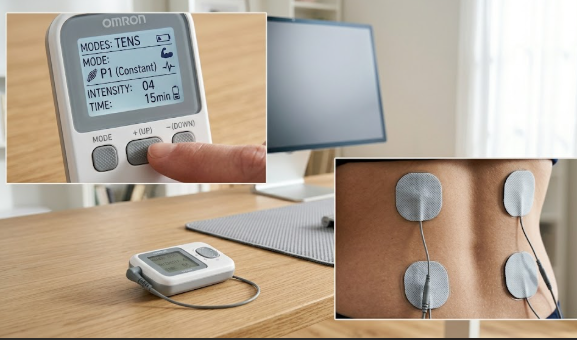
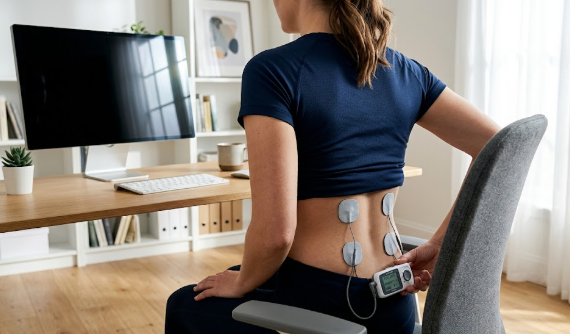
For typical lumbar lower back pain — pain felt in the L1 through L5 region, roughly between the bottom of the ribcage and the top of the pelvis — the standard placement used in clinical settings is paravertebral: two pads on either side of the spine, flanking the painful vertebral level rather than directly on the spinal column. The spine itself should not be directly covered by electrode pads.

For a four-pad setup using both channels of a dual-channel device, place one pad from Channel A above the pain point on the left side of the spine, and one pad from Channel A below the pain point on the left side. Repeat on the right side with Channel B. This “surrounding” placement creates an electrical field that encompasses the painful segment from above and below on each side.

For a two-pad setup on a single channel, place one pad on each side of the spine at the painful level — paravertebral placement, approximately one to two finger-widths from the midline on each side.

The pads should not be placed over the spinal column itself, over broken or irritated skin, over the front of the neck or throat, across the chest (front to back), or directly over bony prominences. Always ensure the skin is clean and dry before applying pads, and remove pads carefully after each session to extend their lifespan.


How to use a TENS unit safely for lower back pain

Begin each session with the intensity set to zero. Place the pads correctly, then slowly increase the intensity on each channel until you feel a tingling sensation — described as “pins and needles” or a mild buzzing. The intensity should be noticeable but not painful or uncomfortable. If you feel sharp pain, burning, or muscle twitching you cannot control, the intensity is too high — reduce it immediately.

Most physical therapists recommend sessions of 20 to 30 minutes for conventional TENS (high-frequency pain gating) and at least 30 minutes for low-frequency endorphin-stimulation modes. The TENS 7000 allows sessions up to 60 minutes; most other consumer units limit to 30 minutes with an auto-shutoff. After a session, some users find relief that lasts several hours; others find 30 to 60 minutes of relief. Individual response varies.

Do not exceed the manufacturer’s recommended daily usage guidelines. Many units recommend no more than one to three sessions per day, with breaks between sessions to allow the skin and underlying tissue to rest. Do not use a TENS unit while sleeping, while driving, or while in water.

Electrode pads are consumable and should be replaced when they lose their adhesion or when the gel surface becomes uneven. Most pads are rated for 20 to 30 uses. Rehydrating the pad surface with a small amount of water can extend lifespan, but oversaturation reduces adhesion. Replacement pads are available for all the devices in this guide at approximately $5 to $15 for a pack of four.


Are TENS units FSA and HSA eligible?

Yes. TENS units are generally FSA (Flexible Spending Account) and HSA (Health Savings Account) eligible when purchased for a medical purpose. The AUVON and iReliev units are explicitly marked FSA/HSA eligible on their Amazon listings. If you have an FSA or HSA, purchasing your TENS unit through those accounts reduces the effective cost by your marginal tax rate.


Frequently asked questions

Does a TENS unit actually work for lower back pain? TENS provides temporary pain relief for many users with lower back pain, particularly muscular and neurological back pain. Multiple systematic reviews, including analyses published in The Cochrane Database of Systematic Reviews, have found evidence that TENS provides short-term pain relief superior to placebo for lower back pain, while noting that evidence for long-term effectiveness is less conclusive. For home users managing daily discomfort from prolonged sitting or muscular lower back pain, it is a well-established non-pharmacological tool with a strong safety profile when used correctly.

How often can I use a TENS unit for back pain? Most manufacturers recommend one to three sessions per day of 20 to 30 minutes each, with breaks between sessions. Continuous use for hours at a time can lead to skin irritation at the electrode sites. Follow the specific guidelines in your device’s user manual for recommended usage frequency.

Can TENS make back pain worse? If used incorrectly — too high an intensity, pads placed directly over the spine, or use during conditions where TENS is contraindicated — TENS can cause skin irritation, burns, or discomfort. For users with undiagnosed back pain, TENS masking pain without treating the cause is a concern, which is why medical evaluation is recommended for persistent or worsening symptoms before relying on TENS for management.

What is the difference between TENS and EMS? TENS (Transcutaneous Electrical Nerve Stimulation) targets nerve fibers to block pain signals. EMS (Electrical Muscle Stimulation) targets muscle fibers to cause contraction. TENS is primarily for pain management; EMS is primarily for muscle rehabilitation and strengthening. Combined TENS/EMS devices like the iReliev ET-7070 provide both modalities.

Can I use a TENS unit while working at my desk? Yes, wired TENS units can be used while seated at a desk as long as you are not driving and the device is on a stable surface. Wireless units offer more freedom of movement. Set the intensity to a comfortable level that does not distract from your work and ensure the lead wires (if wired) are routed safely and will not be caught or pulled.


Conclusion

For most remote workers and office workers managing lower back pain at home, the TENS 7000 remains the most consistently recommended starting point: physical therapist endorsed, the highest maximum output in consumer TENS (100 mA), straightforward to use, and priced at approximately $30 to $50. For users who want modern features — independent dual-channel control, 20 modes, and USB rechargeability — the AUVON Dual Channel delivers all of those at a similar or lower price.

For lower back pain with a significant muscular component, the iReliev ET-7070’s combined TENS and EMS modes address both the pain signal and the underlying muscle tension simultaneously. For users who find lead wires inconvenient, the iReliev Wireless unit provides comparable relief with freedom of movement.

Remember that TENS is a pain management tool, not a treatment. Use it as part of a broader approach that includes appropriate movement breaks, ergonomic setup, and — for persistent or worsening symptoms — consultation with a physician or physical therapist.

Always verify current pricing on Amazon or the manufacturer’s website before purchasing.


Disclaimer: This article is for informational purposes only and does not constitute medical advice. TENS units should not be used by people with pacemakers, implanted electronic devices, epilepsy, or during pregnancy without medical approval. If you have persistent, severe, or worsening back pain, consult a licensed healthcare professional before using a TENS unit or any pain management device. Some links are affiliate links through which we may earn a commission at no additional cost to you.

Leave a Comment

Your email address will not be published. Required fields are marked *

Scroll to Top