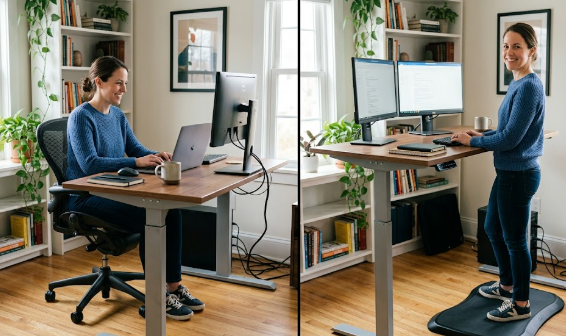
“Sitting is the new smoking” has become one of the most repeated slogans in workplace wellness, and it has sold a lot of standing desks. But when you look past the marketing and into the actual research, the picture is more nuanced and, in some ways, more useful. The evidence does not show that standing is simply good and sitting is simply bad. Instead, it points to a more practical conclusion: the real problem is staying in any single position for too long, and the benefit of a standing desk is not standing itself but the ability to alternate.
This article reviews what the scientific literature says about sitting, standing, and back pain, including where the evidence is reasonably solid and where it remains uncertain. It is a summary of research for general interest, not medical advice. If you want the practical buying side, see our guide to the best standing desks for back pain.
The headline finding: movement beats posture
Across the research, one theme is consistent. The core issue with desk work is not whether you are sitting or standing, but static loading, the sustained stress placed on muscles, tendons, and ligaments when they are held in a fixed position for a long time. Holding any posture for hours reduces circulation and steadily fatigues the tissues that support your spine. This is why studies repeatedly find that both prolonged sitting and prolonged standing can lead to low back discomfort, and why the recommended solution is to change position regularly rather than to pick one posture and hold it all day.
What the research says about sitting
Prolonged sitting has been associated in the literature with a higher prevalence of low back pain and overall musculoskeletal discomfort, alongside broader health concerns linked to total daily sedentary time. Reducing sitting time appears to help: workplace interventions that cut how long computer workers sit have been linked to reductions in lower-back pain. That said, the relationship is not perfectly clean, and reviews have reached somewhat conflicting conclusions, partly because many older studies relied on people estimating their own sitting time, which tends to be inaccurate. The fairest summary is that a lot of uninterrupted sitting is a plausible contributor to back discomfort, and breaking it up is sensible.
What the research says about standing
Here is where the marketing tends to oversimplify. Standing is not a cure, and prolonged standing carries its own risks. A systematic review and meta-analysis that directly compared sitting and standing desk work found that prolonged standing was no better than sitting for perceived low back pain, and the authors cautioned against simply replacing seated work with long periods of standing. Holding a standing posture statically can fatigue the lower back and legs just as a seated one can. In other words, swapping eight hours of sitting for eight hours of standing is not the upgrade it is often sold as.
What the research says about alternating with a sit-stand desk
The more encouraging evidence is for sit-stand workstations used as intended, to move between sitting and standing through the day. A 2018 systematic review and meta-analysis published in Applied Ergonomics concluded that sit-stand workstations may reduce low back pain among workers, while noting that the ideal amount of sitting versus standing has not yet been pinned down. Other reviews have found that providing sit-stand desks reduces total daily sitting time, often by well over an hour, with corresponding increases in standing and light activity. A long-term, industry-supported workplace study reported that a substantial share of users experienced fewer aches in the back, shoulders, and neck after a year, though findings from industry-funded work should be read with that context in mind.
The mechanism makes sense: by alternating, you interrupt static loading, keep your circulation moving, and give overworked tissues a chance to recover. The desk is best understood as a tool that makes movement easy, not as a posture that is healthy in itself. You can read one of the key reviews on PubMed, and the University of Waterloo’s musculoskeletal research centre has a useful overview of the evidence.
How much should you sit versus stand?
This is the question the research has not fully answered. Reviewers note that the gold-standard ratio of sitting to standing is currently unknown, which is an honest limitation worth stating plainly. There are early clues, however. A randomized trial published in 2026 compared fixed and self-selected sit-stand ratios in desk workers and found that a structured pattern of roughly thirty minutes sitting to fifteen minutes standing produced greater reductions in worst lower-back pain than letting people choose their own rhythm, with additional benefits reported for neck pain, stress, and concentration. That points toward a practical rule of thumb: a regular, proactive schedule of changing position seems to beat both holding one posture and changing only when you already feel sore.
What the evidence does and does not show
The table below summarises the broad picture. As with any evolving field, individual studies vary, and these are general conclusions rather than guarantees.
| Question | What the research broadly suggests |
|---|---|
| Is prolonged sitting linked to back pain? | Plausibly yes; reducing it appears to help, though evidence is mixed. |
| Is standing all day better than sitting all day? | No; prolonged standing is no better and has its own risks. |
| Do sit-stand desks (alternating) help? | They may reduce low back discomfort and cut sitting time. |
| What is the ideal sit-stand ratio? | Not firmly established; a structured 30:15 pattern shows early promise. |
| What matters most? | Regular movement and avoiding any sustained static posture. |
Important caveats in the research
A balanced reading requires noting the limitations. Much of the literature studies people without pre-existing back pain, so the effects on those who already have chronic low back pain are less well understood. Some of the most favourable figures come from industry-funded studies. Measuring real sitting and standing time has historically been imprecise. And proper training matters: studies find that simply giving someone a sit-stand desk does little unless they actually use it to change posture regularly. None of this means the desks do not help; it means the honest conclusion is “promising and reasonable, with the optimal approach still being refined,” rather than a guaranteed fix.
Practical takeaways
Translating the evidence into everyday habits is straightforward. Do not aim to stand all day; aim to break up long stretches of either posture. Change position proactively on a schedule rather than waiting until your back aches, since by then you have usually waited too long. Add genuine movement where you can, because walking beats both standing and sitting still. If you have existing back pain, start with shorter standing intervals and build up gradually. And remember that your equipment still matters during the seated periods: a supportive chair with good lumbar support makes the sitting portion of your day far kinder to your spine, as covered in our best ergonomic chairs guide. For the standing portion, an anti-fatigue mat helps, which is why we cover the best standing desk mats separately, and a few back pain exercises round out the routine.
Frequently asked questions
Is sitting really “the new smoking”?
That slogan overstates the science. Prolonged sedentary time is genuinely associated with health risks, including back discomfort, but the comparison to smoking is rhetorical rather than evidence-based. The more accurate takeaway is that staying in any one position for too long is the problem, and regular movement is the remedy.
Will a standing desk fix my back pain?
Not on its own. The research suggests sit-stand desks may reduce low back discomfort when used to alternate between sitting and standing, but standing all day is no better than sitting all day. The benefit comes from changing position and moving, so a standing desk helps most as a tool that makes that easy, alongside a good chair and regular activity.
What is the best sit-stand ratio?
The ideal ratio has not been firmly established by research. A 2026 trial found that a structured pattern of about thirty minutes sitting to fifteen minutes standing outperformed self-selected schedules for reducing worst lower-back pain, which makes it a reasonable starting point, but individual needs vary. Begin conservatively and adjust to what feels comfortable.
Can standing too much cause back pain?
Yes. Prolonged static standing can fatigue the lower back and legs and carries its own discomfort risks, which is why research advises against simply replacing all-day sitting with all-day standing. As with sitting, the key is not to hold the position for hours but to keep alternating and moving.
The bottom line
The honest verdict from the research is that the sitting-versus-standing debate is the wrong framing. Both, held statically for hours, can contribute to back discomfort, and the evidence favours alternating between them and moving regularly, with sit-stand desks shown to help when used that way. The optimal ratio is still being refined, but a structured, proactive habit of changing position is the practical message. Set up both your sitting and standing time well, using our home office ergonomic setup guide, and let movement, not a single posture, do the work.
Medical disclaimer: This article summarises general research for informational purposes only and is not medical advice, diagnosis, or treatment. Scientific evidence evolves and individual circumstances vary, so the findings described may not apply to your situation. If you have persistent, severe, or worsening back pain, please consult a qualified healthcare professional.